
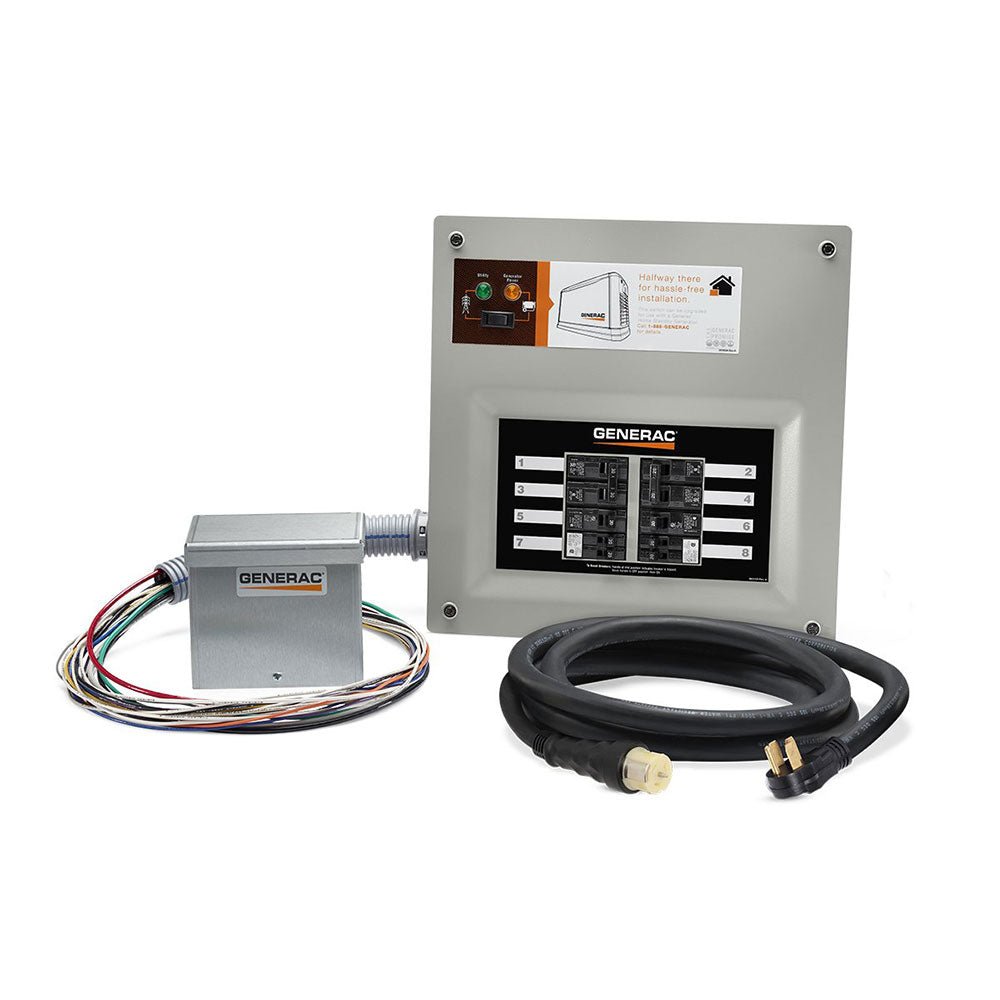
Knowing how to connect generator to house wiring safely comes down to one rule: use a transfer switch installed by a licensed electrician. The generator plugs into an outdoor power inlet box with a matching generator cord, and the switch feeds your circuits while keeping them isolated from the utility. Never plug a generator into a wall outlet. CPSC calls this “backfeeding” and warns that it puts utility workers and neighbors at risk of electrocution.
This guide covers the three safe options, how to match the cord and inlet to your generator, how you use the system once it is installed, and what it costs. Browse our manual transfer switches and generator accessories as you read.
How to connect generator to house wiring: the three safe options
1. Manual transfer switch, power inlet box and generator cord
This is the most common setup for a portable generator. An electrician mounts a weatherproof power inlet box on the outside wall, wires it to a manual transfer switch next to your main panel, and connects the circuits you want to back up. During an outage you run a cord from the generator to the inlet box and flip the switch. Examples from our range:
- Generac 9854 HomeLink: 50 A, 120/240 V, 12,000 rated watts, 10 circuits expandable to 16, field-upgradable to an automatic switch. It needs a power inlet box and cord, sold separately.
- Generac 9855 HomeLink kit: the same switch plus a 10-foot 50 A NEMA 14-50P to CS6364 cord and a 50 A aluminum power inlet box.
- Generac GNC-6333 (60 A, up to 15,000 watts) and GNC-6334 (100 A, up to 25,000 watts): indoor single-load transfer panels that can feed a sub-panel.
2. Interlock kit, where allowed
An interlock is a mechanical device fitted to your main panel that prevents the main breaker and the generator breaker from being on at the same time. The Eugene Water & Electric Board says you must use a UL-approved transfer switch or interlock to prevent backfeed and recommends a licensed electrician install it. Whether an interlock is accepted depends on your panel and your local code, so ask your electrician and building department. It still needs a properly wired inlet box and cord.
3. Automatic transfer switch for a standby generator
A permanently installed standby generator uses an automatic transfer switch that senses the outage, starts the generator and transfers the load without you doing anything. See automatic vs manual transfer switches for a full comparison.
Match the cord, inlet and generator: 30 A vs 50 A
The generator’s largest 120/240 V receptacle determines the rest of the chain. The inlet box, cord and transfer switch should all be rated for that amperage, and OSHA warns against using underrated cords. The electrician sizes these parts during installation.
| 30 A system | 50 A system | |
|---|---|---|
| Generator receptacle | L14-30R (30 A, 125/250 V twist-lock) | 14-50R (50 A, 125/250 V) |
| Cord | 30 A L14-30 generator cord | Generac GNC-6330: 10 ft, 6-gauge, NEMA 14-50 plug to locking CS6364 connector, up to 12,500 W at 240 V |
| Inlet box | Generac GNC-6340 (raintight nylon, L14-30) or GNC-6346 (aluminum), listed for generators up to 7,500 W | Generac GNC-6338: 50 A, 4-wire twist-lock, raintight, up to 12,500 W |
| Generators in our range with this outlet | DuroMax XP5500HX, Generac GP8000E, Winco DP7500, Winco HPS9000VE | DuroMax XP13000HXT, DuroMax XP15000HX, DuroMax XP15000HXT |
A 30 A system suits generators up to about 7,500 watts; the 50 A parts above are listed up to 12,500 watts. Do not try to push more power through a smaller inlet or cord than it is rated for. For help choosing a generator, see our planned guide to the best portable generators for home backup.
How to hook up a generator to your house once the switch is installed
This is the homeowner’s routine after a licensed electrician has installed the switch and inlet. It follows Generac’s published manual-transfer procedure; always follow your own equipment manuals.
- Set the generator outdoors on a dry surface, at least 20 feet from the house with the exhaust pointed away from doors, windows and vents (CPSC).
- Turn off heavy-load appliances and confirm the transfer switch is in the UTILITY position.
- Connect the generator cord to the generator and to the power inlet box.
- Start the generator and let it warm up for 1 to 2 minutes.
- Move the transfer switch from UTILITY to GEN.
- Turn on essential circuits one at a time, staying within the generator’s continuous (running) watt rating.
- When utility power is back and stable, move the switch from GEN to UTILITY, stop the generator and let it cool before disconnecting and storing the cord in a dry place.
What never to do
- Never backfeed through an outlet. CPSC says plugging a generator into a wall outlet is extremely dangerous, puts utility workers and neighbors on the same transformer at risk of electrocution, and bypasses household circuit protection. OSHA adds that connecting without a properly installed transfer switch can energize wiring systems for great distances.
- Never use a “suicide cord.” Consumer Reports explains that a male-to-male cord leaves exposed, live prongs on the free end, can send power back onto utility lines, and can overload your wiring when grid power returns.
- Never run a generator indoors, in a garage, basement, crawlspace or shed, even with doors and windows open (CPSC).
- Do not do the wiring yourself. Only a licensed electrician should install a transfer switch or interlock, and you may need a permit from your local building department (This Old House, EWEB).
Carbon monoxide safety
In a 2024 safety release, CPSC estimated that portable generators have been associated with 796 non-fire CO poisoning deaths since 2010, 40 percent of all non-fire CO deaths related to consumer products. CO is invisible and odorless. Install battery-operated CO alarms (or plug-in alarms with battery backup) on each level of the home and outside sleeping areas, and look for generators with automatic CO shut-off. If you feel dizzy or weak, get to fresh air right away. In rain, CPSC advises operating the generator under an open, canopy-like structure on a dry surface, never indoors.
Transfer switch installation cost
Consumer Reports puts a professionally installed transfer switch at $800 to $2,000, and HomeAdvisor lists manual switches at $500 to $2,000. On our site, the four manual transfer switches list from about $170 to $800 and our three power inlet boxes from about $60 to $80; these are list prices that change. Labor, permits and the distance from the inlet to your panel make up the rest.
Frequently asked questions
Can I plug my generator into a dryer outlet?
No. That is backfeeding. CPSC and OSHA warn it can electrocute utility workers and neighbors and bypasses your circuit protection. Use a transfer switch or approved interlock installed by a licensed electrician.
Do I need a 30 amp or 50 amp generator inlet box?
Match it to the generator’s largest 240 V receptacle. An L14-30R generator uses a 30 A inlet such as the Generac GNC-6340; a 14-50R generator uses a 50 A inlet such as the GNC-6338 with a 50 A cord.
What cord do I need for a 50 amp generator?
A 50 A cord that matches both ends, such as the Generac GNC-6330: 10 feet of 6-gauge cable with a NEMA 14-50 plug and a CS6364 locking connector, rated up to 12,500 watts at 240 V.
Do I need a permit to connect a generator to my house?
Often, yes. This Old House advises getting any necessary permits from your local building department, and the work should be done by a licensed electrician.
Sources
- CPSC Safety Alert: Portable Generator Hazards
- CPSC: Stay Safe While Staying Warm This Winter
- OSHA Fact Sheet: Using Portable Generators Safely
- Eugene Water & Electric Board: Generator safety
- Generac Support: How to do a manual power transfer
- Consumer Reports: Why suicide extension cords are so dangerous
- This Old House: How to wire a portable generator
- HomeAdvisor: Whole-house generator installation cost