
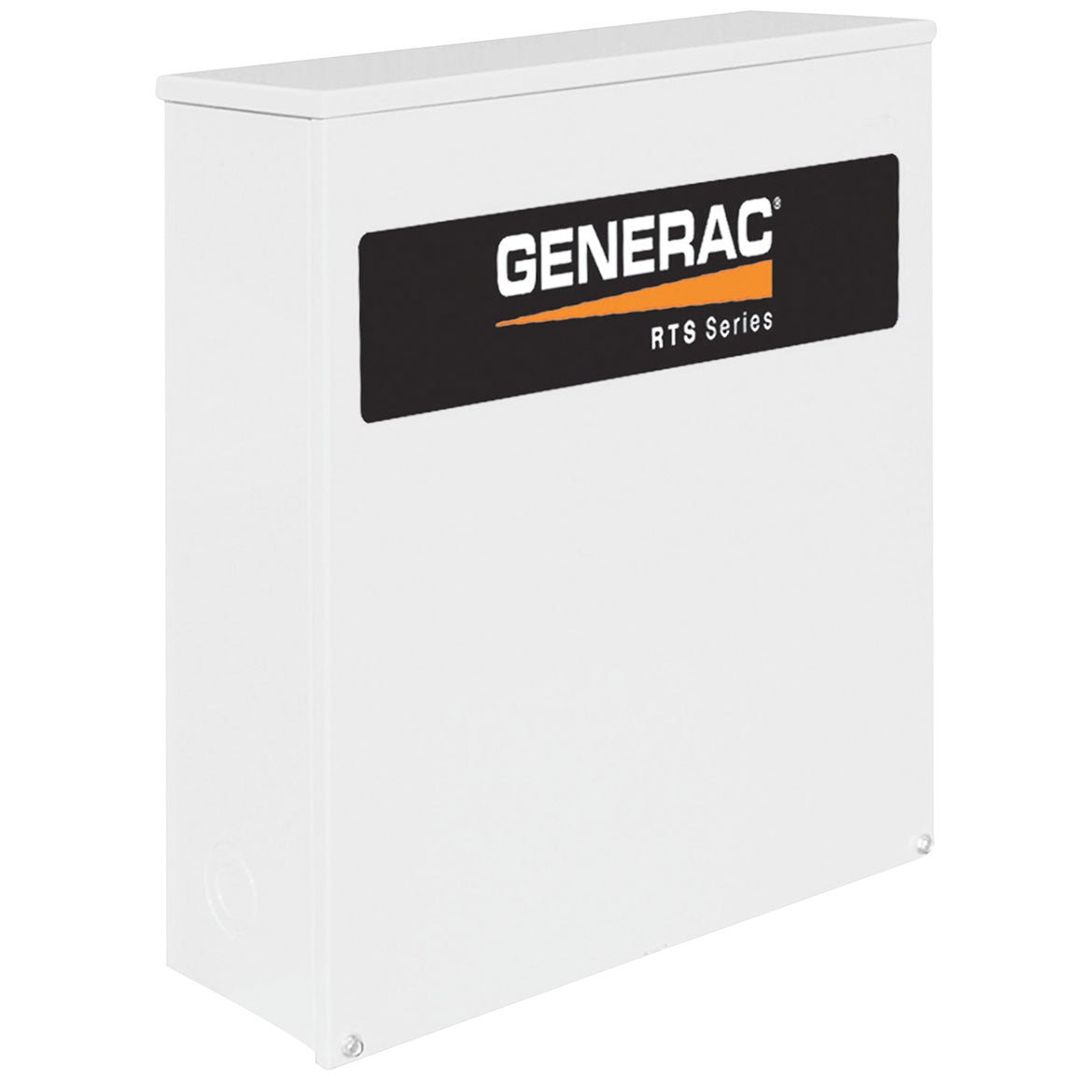
What Is a Transfer Switch? Automatic vs Manual Transfer Switches
A transfer switch is the device that safely connects a generator to your home’s wiring. It disconnects your house from the utility line before generator power flows in, so the generator cannot “back-feed” into the power lines and the grid cannot back-feed into your generator. There are two kinds: automatic transfer switches for standby generators and manual transfer switches for portable generators.
Shop all generator transfer switches.
Why you need a transfer switch
- Safety for line workers. Back-feeding a home’s wiring through a plug, sometimes called a “suicide cord”, can energize the utility line and electrocute crews working to restore power. It is dangerous and against electrical code.
- Protection for your generator and home. When grid power returns, a transfer switch keeps it from hitting a running generator.
- Convenience. You power hard-wired circuits such as the furnace, well pump and lights directly, instead of running extension cords.
Electrical codes require approved transfer equipment for any generator connected to building wiring. A licensed electrician must install it, and a permit is usually needed.
How an automatic transfer switch works
An automatic transfer switch (ATS) watches the utility voltage. When the power fails it signals the standby generator to start, waits a few seconds for stable output, then moves your load to the generator. When utility power returns and stays stable, it switches back and lets the generator cool down and shut off. You do not have to be home.
- Sizing: match the switch to your service, usually 100, 200 or 400 amps, and to your voltage and phase. Examples are the Generac Guardian 100 amp, 200 amp three-phase and 400 amp models.
- Service-rated switches include a main breaker and can serve as your service disconnect, which often simplifies installation.
- Smart switches with load management, such as the Generac RXSW100A3 and RXSW 200 amp Smart Switch, can shed large loads like AC units with Smart Management Modules, so a smaller generator covers more of the house.
- Load-center switches like the Generac RXG16EZA3 combine the switch with a 16-circuit panel for essential-circuit backup.
How a manual transfer switch works
A manual transfer switch is installed next to your main panel and wired to the circuits you choose, typically 6 to 10. During an outage you:
- Set up your portable generator outdoors, well away from doors and windows.
- Plug it into a power inlet box on the outside wall with a generator cord.
- Start the generator, then move each circuit’s switch from “Line” to “Gen”.
- When utility power returns, switch the circuits back to “Line” and shut the generator down.
Options include the Generac HomeLink 50 amp 10-circuit switch, the HomeLink kit with inlet box and cord, and the Generac 60 amp manual transfer switch. Generator cords and inlet boxes are in generator accessories.
Automatic vs manual transfer switch: side by side
| Automatic transfer switch | Manual transfer switch | |
|---|---|---|
| Generator type | Permanently installed standby generator | Portable generator |
| Who switches it | Switches by itself within seconds | You, by hand |
| Works when you are away | Yes | No |
| Circuits covered | Whole house or a load center | Selected circuits |
| Cost | Higher | Lower |
Transfer switch vs interlock kit
An interlock kit is a mechanical plate on your main panel that prevents the main breaker and a generator breaker from being on at the same time. It is a lower-cost way to feed a portable generator into the whole panel, but you manage loads yourself by switching breakers. Interlocks are panel-specific and are not allowed everywhere, so ask your electrician. A transfer switch is a dedicated, clearly labelled device and is the standard choice for standby generators.
Frequently asked questions
Do I need a transfer switch for a portable generator?
If you want to power anything hard-wired, such as a furnace, well pump or lighting circuits, yes: a transfer switch or an approved interlock. Plugging appliances directly into the generator with extension cords does not need one.
What size transfer switch do I need?
For a standby generator, match your service size (100, 200 or 400 amps) and the generator’s output. For a portable generator, match the generator’s outlet. A 30 amp L14-30 outlet pairs with a 30 amp switch, and a 50 amp outlet with a 50 amp switch.
Can I install a transfer switch myself?
No. It ties into your service panel and must be installed by a licensed electrician, with a permit where required.
Which generator do I pair it with?
See our standby generator sizing guide or browse home standby generators.