Best Espresso Grinders: How to Choose the Right One
The best espresso grinder for you is the one that can grind fine and consistently enough for espresso, adjusts in tiny steps, and fits the way you make coffee. Your grinder matters as much as your espresso machine. Even a great machine cannot fix uneven or stale grounds.
Below is how to choose, followed by the grinders we recommend by budget and use. All of them are in our espresso grinders range.
What makes a good espresso grinder
Fine, stepless adjustment
Espresso is dialed in by tiny grind changes. Look for stepless adjustment, or very fine micro-steps, so you can move the grind a fraction at a time. Most grinders made for drip and French press do not adjust finely enough for espresso.
Burr type and size
- Flat burrs give a uniform grind and tend to produce a clearer, more defined espresso. Larger flat burrs grind faster and cooler. Examples are 55 mm in the Eureka Mignon, 75 mm in the Atom Specialty 75 and 83 mm in the Ceado E37Z.
- Conical burrs are compact, quiet and forgiving, with a slightly heavier body in the cup. The Baratza Sette 270Wi uses 40 mm conical burrs.
Neither type is “better” for everyone. Burr quality and alignment matter more than shape.
Retention and freshness
Retention is the coffee left inside the grinder after each dose. Low retention keeps every shot fresh and makes it easy to switch beans.
Hopper vs single dose
- Hopper grinders hold a bag of beans and grind on demand. They are convenient if you drink the same coffee every day.
- Single dose grinders grind only the beans you weigh in, with near-zero retention. They are ideal if you like switching coffees or want the freshest possible dose.
Grind by time or by weight
Most grinders dose by time. Weight-based grinders such as the Eureka Mignon Libra and Baratza Sette 270Wi stop at a target weight, so you skip the scale.
Best espresso grinders we carry, by need
Best all-round home espresso grinder: Eureka Mignon Specialita
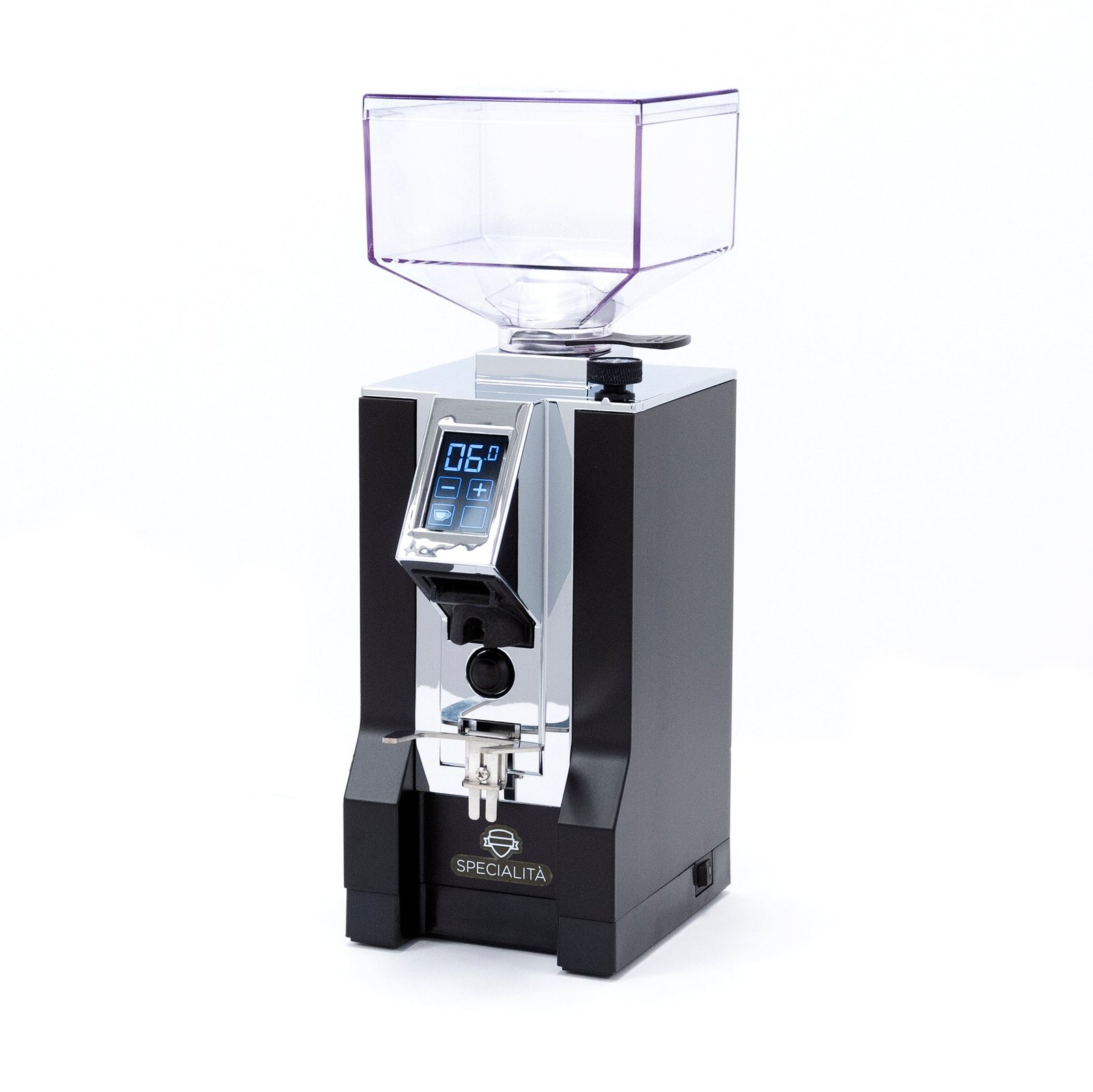
The Eureka Mignon Specialita pairs 55 mm flat hardened steel burrs with stepless adjustment, a touchscreen timer and a famously quiet build. It suits most home espresso setups. The Mignon Magnifico uses 55 mm Diamond Inside burrs, and the Mignon Perfetto is a smaller-budget option with 50 mm burrs.
Best grind-by-weight: Eureka Mignon Libra or Baratza Sette 270Wi
Both dose to a target weight. The Libra uses 55 mm flat burrs. The Sette 270Wi is fast, compact and conical.
Best single dose grinder: Eureka Oro Mignon Single Dose or Ceado E5SD
The Eureka Oro Mignon Single Dose uses 65 mm Diamond Inside burrs, and the Single Dose Pro adds more control. The Ceado E5SD grinds very fast with 64 mm flat burrs.
Best for flat-burr enthusiasts and small cafés: Eureka Atom Specialty
The Eureka Atom Specialty 75 (75 mm burrs) and Atom Specialty 65 are commercial-grade on-demand grinders that are still at home on a kitchen counter.
Best compact value flat-burr: LX Newton 55 and Edison 65
The LX Newton 55 and LX Edison 65 offer 55 mm and 65 mm flat steel burrs at an accessible price.
Best for espresso and filter: Mahlkönig X54
The Mahlkönig X54 uses 54 mm flat steel burrs and switches between espresso and pour over easily.
Best commercial espresso grinders: Anfim ALBA and LUNA, Ceado E37Z
For cafés and serious home bars, the Anfim ALBA (80 mm flat burrs), Anfim LUNA (65 mm) and the Ceado E37Z-Barista (83 mm) are built for volume. See all commercial coffee grinders.
Not for espresso: Fellow Ode Gen 2
The Fellow Ode Brew Grinder Gen 2 is an excellent 64 mm flat burr grinder for pour over, drip and French press. It is not designed to grind fine enough for espresso.
Flat vs conical burrs
| Flat burrs | Conical burrs | |
|---|---|---|
| Grind consistency | Very uniform | Slightly wider spread of particle sizes |
| Typical taste | Clarity, defined flavors | Body, chocolatey texture |
| Speed and heat | Larger burrs grind faster and cooler | Low speed, low heat |
| Size | Usually taller and heavier | Compact |
Frequently asked questions
How much should I spend on an espresso grinder?
A common rule is to budget about as much for the grinder as for the machine, or at least half. A capable espresso grinder starts around $450 to $650. Single dose and commercial models cost more.
Can I use one grinder for espresso and pour over?
Yes, with an all-round grinder that adjusts easily across a wide range, such as the Mahlkönig X54, Baratza Vario models or the Mignon Specialita. Frequent switching is easier on a single dose grinder.
Is a refurbished grinder worth it?
Refurbished grinders can save a meaningful amount. Ours are clearly labelled. Browse refurbished coffee grinders.