
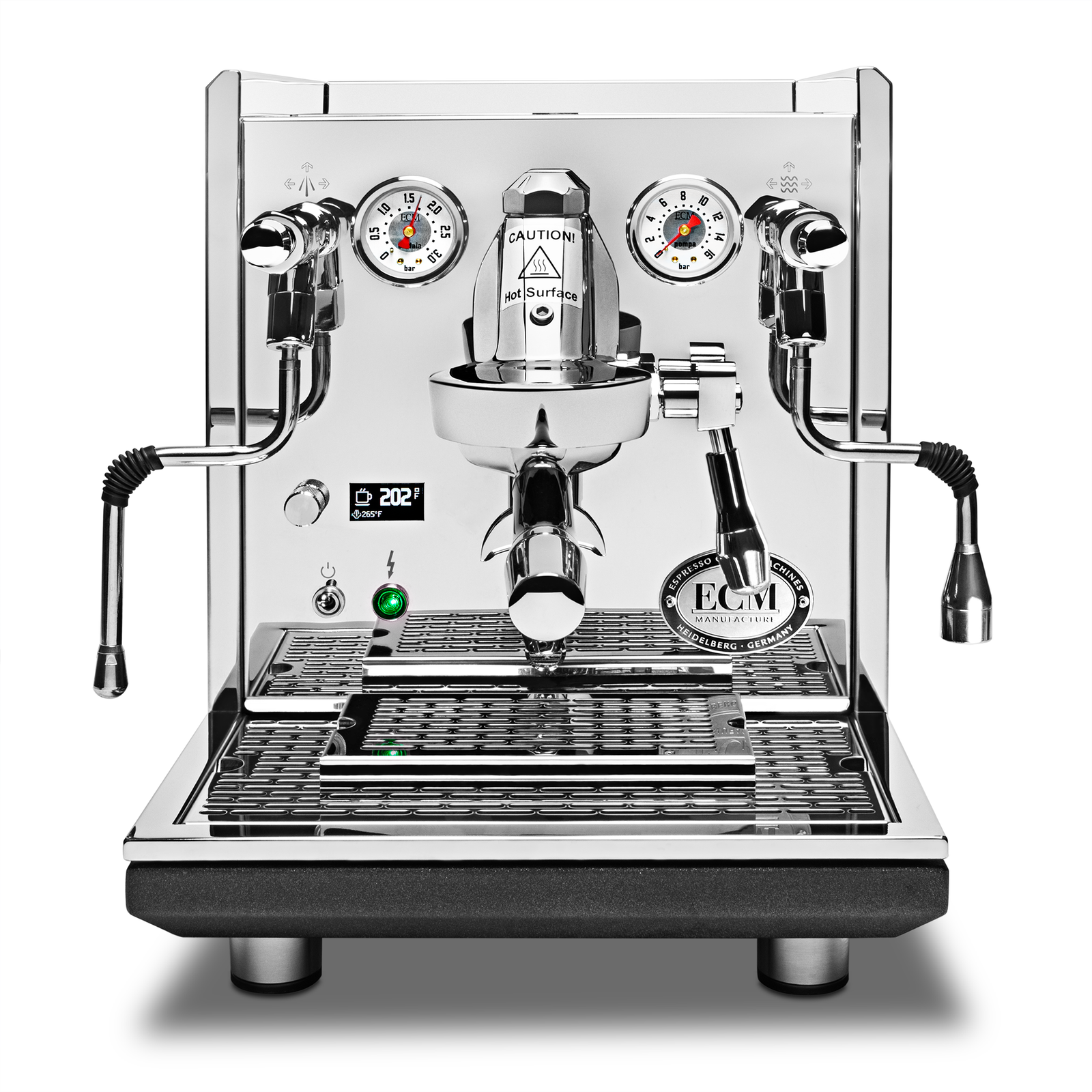
Dual Boiler vs Heat Exchanger vs Single Boiler Espresso Machines
Semi-automatic espresso machines come in three main boiler designs: single boiler, heat exchanger (HX) and dual boiler. The design decides whether you can brew and steam milk at the same time, how precisely you can control brew temperature, and how much the machine costs. Here is how to choose.
Single boiler espresso machines
A single boiler machine has one boiler that serves both brewing and steaming. It sits at brew temperature for espresso, then heats up further when you switch to steam. You brew first, wait for steam, then froth milk.
- Pros: lowest price, compact, quick to heat, excellent espresso, especially with PID control.
- Cons: you cannot brew and steam at once, and there is a wait between espresso and milk.
- Best for: espresso drinkers and people who make one milk drink at a time.
Examples: the Profitec GO, ECM Classika PID, ECM Casa V and the espresso-only ECM Puristika. See all single boiler espresso machines.
Heat exchanger (HX) espresso machines
A heat exchanger machine keeps one large boiler at steam temperature. A copper tube, the heat exchanger, runs through that boiler. Fresh water passes through the tube on its way to the group and heats to brewing temperature as it goes, so you can pull a shot and steam milk at the same time.
- Pros: brew and steam simultaneously, powerful steam, classic E61 machines at a mid-range price.
- Cons: brew temperature is set indirectly. Many non-PID HX machines need a short “cooling flush” before a shot if they have been idle. PID models make this more consistent.
- Best for: milk drinks for two to four people at a time.
Examples: the Profitec Pro 400, Pro 500 PID, ECM Mechanika VI Slim, Mechanika Max and Technika V Profi PID. See all heat exchanger espresso machines.
Dual boiler espresso machines
A dual boiler machine has two separate boilers: a brew boiler held at your chosen espresso temperature and a steam boiler for milk. Each normally has its own PID controller.
- Pros: precise, stable brew temperature with no cooling flush, simultaneous brewing and steaming, and easy temperature changes for different coffees.
- Cons: higher price, larger footprint and longer heat-up on some models.
- Best for: enthusiasts who experiment with roasts and want maximum control, and busy households making many milk drinks.
Examples: the Profitec Pro 300, Rancilio Silvia Pro, Profitec Pro 600, Profitec MOVE, Profitec RIDE, Pro 700, Profitec Drive and the ECM Synchronika II. See all dual boiler espresso machines.
Comparison table
| Single boiler | Heat exchanger | Dual boiler | |
|---|---|---|---|
| Brew and steam at once | No | Yes | Yes |
| Brew temperature control | Good with PID | Indirect, better with PID | Precise, direct |
| Cooling flush needed | No | Often, on non-PID models | No |
| Steam power | Modest | Strong | Strong |
| Price range in our store | About $980 to $1,700 | About $1,450 to $2,400 | About $1,700 to $3,700 |
What is an E61 group head?
The E61 is a heavy, chrome-plated brass group head first introduced by Faema in 1961. Water circulates through it to keep it hot, and it has a gentle mechanical pre-infusion. Many heat exchanger and dual boiler machines from ECM and Profitec use it, which is why it is known for temperature stability and easy servicing. Some newer models, such as the Profitec Pro 300 and Rancilio Silvia Pro, use their own group designs instead.
Other features to compare
- Vibration vs rotary pump: rotary pumps are quieter and can often be plumbed into a water line. The Synchronika, Drive and Pro 700 are examples.
- Flow control: a paddle or valve that changes water flow during the shot for more extraction control, available on several Profitec models.
- Shot timer and eco mode: handy everyday features on many newer machines.
Whatever you choose, budget for a good grinder. Our espresso grinder buying guide explains why.
Frequently asked questions
Is a dual boiler worth it over a heat exchanger?
If you value precise, adjustable brew temperature and do not want to cooling-flush, yes. If you mainly make milk drinks and want strong steam at a lower price, a PID heat exchanger is excellent value.
Can a single boiler machine make lattes?
Yes. You pull the shot, switch to steam, wait for the boiler to heat, then froth. It works well for one or two drinks.
Do refurbished machines perform the same?
Our refurbished espresso machines are clearly marked. See each product page for its condition and warranty details.