
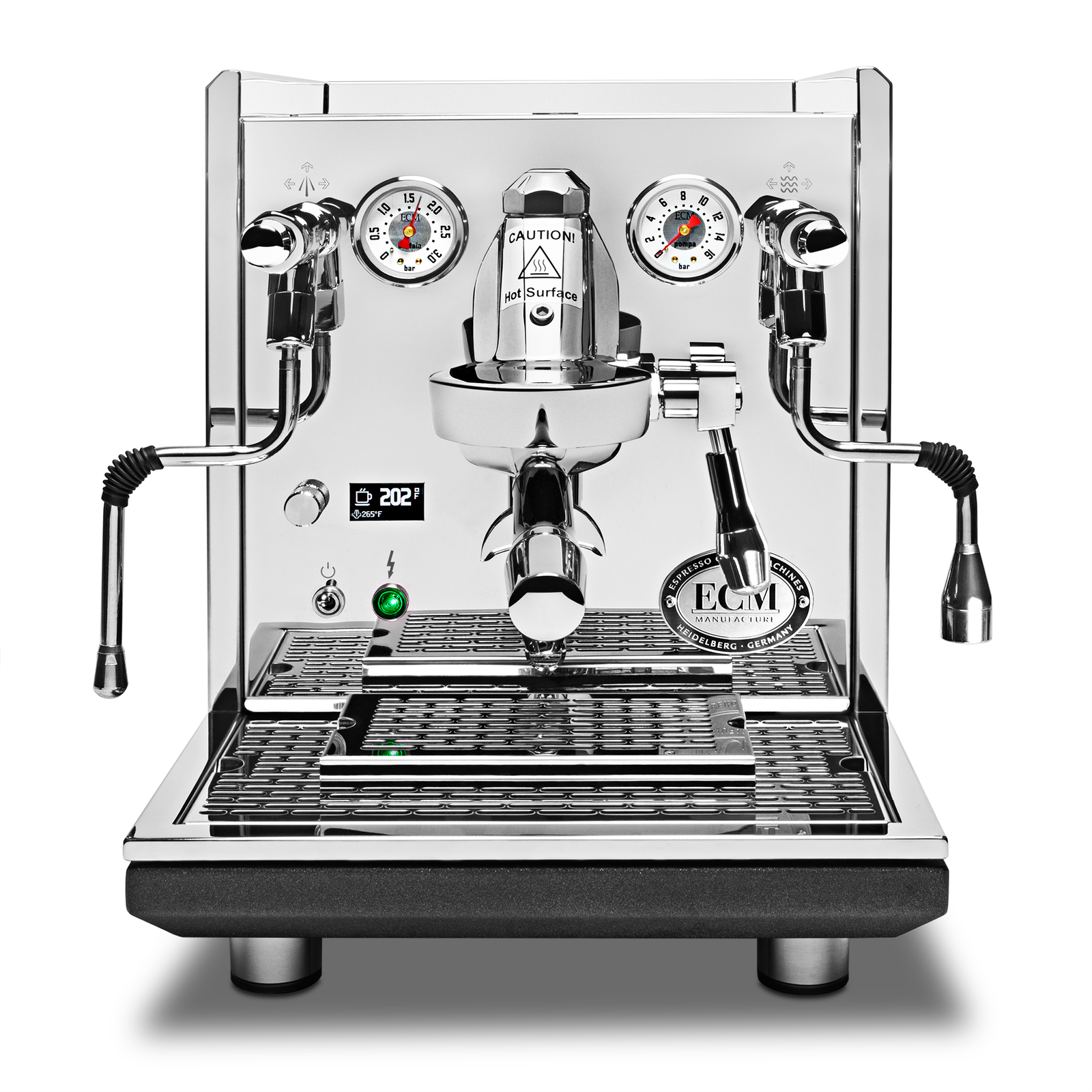
The main espresso machine parts are the water supply, pump, boiler or heating system, group head, portafilter and basket, shower screen and gasket, valves, temperature controller, steam wand and hot water tap, gauges and drip tray; the pump pushes heated water through the group head into the coffee, and the boiler also makes steam for milk.
The main espresso machine parts are the water supply (a tank or a plumbed line), the pump, the boiler or heating system, the group head, the portafilter and basket, the shower screen and gasket, the valves, the temperature controller, the steam wand and hot water tap, the gauges and the drip tray. The pump pushes heated water through the group head and into a puck of finely ground coffee held in the portafilter, and the boiler also makes steam for milk.
This guide follows the water through a semi-automatic machine, explains each component and flags the parts that wear. Examples come from machines on our E61 espresso machines page, and only where the listing states the part.
How does an espresso machine work?
An espresso machine moves water through these steps:
- Water leaves the tank or water line.
- The pump raises it to brewing pressure.
- The heating system brings it to brewing temperature.
- When you start a shot, water flows through the group head.
- It spreads out through the shower screen.
- It is forced through the coffee in the portafilter basket.
ECM’s manual for its Mechanika machines notes that if the coffee is ground too coarsely, the machine cannot build more than 9 bar of brewing pressure. Steam and hot water come from a separate boiler or from the space above the water in a single boiler.
Espresso machine parts, step by step
1. What is the water tank or plumbed line?
Most home machines draw from a removable tank. ECM lists tanks of 3, 2.8 or 2 liters depending on the model, and the ECM Synchronika II tank holds an adapter for a water filter cartridge. Some machines can also be connected to a water line. ECM’s Synchronika II manual asks for a supply between 1 and 2 bar, recommends a pressure regulator and shut-off valve when line pressure is higher, and says installation must be done by a qualified specialist. In our catalog the Profitec Drive and ECM Synchronika II listings state they can be plumbed, while the Profitec Pro 600 listing states reservoir only.
2. What does the pump do?
The pump creates brewing pressure. Home machines use either a vibratory pump or a rotary pump. Profitec explains the difference:
- Vibratory pump: can produce 15 bar, reduced to 9 to 10 bar by an expansion valve; cheaper but audible.
- Rotary pump: larger, heavier and almost noiseless.
Our guide to rotary vs vibratory pumps covers the trade-offs in detail.
3. What heating systems does an espresso machine use?
The heating system decides whether you can brew and steam at the same time:
- Single boiler: one boiler for brewing and steam, so you brew and then steam in sequence (ECM). Example: ECM Classika PID.
- Heat exchanger: one steam boiler with a tube running through it. ECM describes this as two separate water circuits, with fresh brew water heated indirectly by the boiler, so you can brew and steam together. The ECM manual calls for a short cooling flush to clear overheated water from the heat exchanger. Example: ECM Mechanika VI Slim, with a 2.2 L boiler per its listing.
- Dual boiler: separate brew and steam boilers with independent temperatures, and the steam boiler can be switched off when you do not need it (ECM). Example: the Synchronika II, listed with a 0.75 L brew boiler and a 2 L steam boiler.
- Thermoblock: an in-line heater. Nestlé’s patent describes it as a metal mass with a duct running through it, heating water as it flows rather than storing it. Our JURA C3 listing names a thermoblock, and the JURA GIGA X8 lists dual thermoblocks.
For a deeper comparison, see dual boiler vs heat exchanger vs single boiler.
4. What is a pressurestat or PID?
Something has to switch the heating element on and off. La Marzocco describes the older thermostat or pressurestat as a simple mechanical switch that turns the boiler on below a set point and lets it overshoot at the top. A PID controller constantly reads the boiler temperature and varies how long the element stays on, which gives much finer control. The ECM Mechanika Max listing says its PID regulates the boiler by brew group temperature. More in our PID espresso machine guide.
5. What is the group head?
The group head is where the portafilter locks in and where water enters the coffee. The best-known design is the E61, which Profitec describes as a group weighing 4 to 5 kg; the ECM Puristika listing notes that its E61 group circulates hot water from the boiler for consistent brew temperature. On an E61 lever machine, ECM’s manual explains that when you lower the brew lever, the remaining pressure and water drain into the drip tray through the bottom of the group. More in what is an E61 group head. ECM’s Synchronika II adds heating cartridges to its brew group to shorten warm-up.
6. What is a solenoid valve?
Machines that start brewing electronically rather than with a mechanical E61 cam use a solenoid valve to open and close the water path to the group. ECM’s Synchronika II manual, for example, describes the solenoid valve staying open while the pump pauses during active pre-infusion.
7. What is the expansion valve (OPV)?
The expansion or over-pressure valve caps brewing pressure. ECM’s Mechanika manual lets you set it between about 8.5 and 12 bar with a screw under the cup tray. In our catalog, the Profitec RIDE lists an externally adjustable OPV and the ECM Casa V lists an accessible overpressure valve.
8. What are the shower screen and group gasket?
The shower screen spreads water evenly over the coffee, and the rubber group gasket seals the portafilter against the group. These are the main wear parts. ECM tells owners to wipe both daily, and its troubleshooting table says a dripping portafilter can mean a broken gasket, fixed by replacing the gasket and shower screen together. Profitec’s care guide gives the same trigger: water escaping past a firmly locked portafilter. Barista Magazine adds that brittle, hard or cracked gaskets and damaged or caked screens should be replaced, ideally before they get that far.
9. What are the portafilter and baskets?
The portafilter is the handle that holds a filter basket of ground coffee. ECM’s Mechanika manual refers to one- and two-cup baskets plus an included blind basket for group cleaning, and recommends a 58 mm tamper. The Profitec MOVE listing adds a modular bottomless portafilter.
10. What do the steam wand and hot water tap do?
The steam wand draws steam from the boiler to heat and froth milk; the hot water tap dispenses water for tea or americanos. ECM’s manual gives these steps for using the steam wand:
- Open the steam valve for about 5 seconds first to clear condensed water.
- Keep the tip under the milk surface.
- Purge again afterward to keep the holes clear.
- Wipe the wand after every use.
ECM also warns against closing steam and hot water valves to the last stop, which protects their gaskets. The Puristika listing describes it as espresso-only, with no steam wand.
11. What do the gauges show?
Most prosumer machines show two pressures. The pump or brew pressure gauge shows pressure during the shot, and Barista Magazine says it should read about 9 bar while brewing. The boiler gauge shows steam pressure; ECM’s heat exchanger manual says to wait for about 1.0 to 1.25 bar before use. The 969.Coffee Elba 3 combines both on a dual needle gauge.
12. What does the drip tray do?
The drip tray catches flush water, purged steam and the water vented from the group after each shot. ECM says to clean it daily and empty it regularly rather than waiting until it is full.
Which espresso machine parts wear out?
| Part | What wears | Cue or care tip |
|---|---|---|
| Group gasket | Rubber hardens and cracks | Leaks around a locked portafilter |
| Shower screen | Coffee build-up, damaged mesh | Visible caking or separation |
| Steam and hot water valves | Valve gaskets | ECM: do not force valves to the last stop |
| Pump | Mechanical wear | Fails to reach 9 bar or gets noisy (Barista Magazine) |
| Expansion valve | Drifts out of adjustment | Pressure above 12 bar (Barista Magazine) |
Routine cleaning keeps the gasket, screen and group healthy; see how to clean an espresso machine. Internal parts such as boilers and pumps are dealer or technician work.
Frequently asked questions
What are the main components of an espresso machine?
A water supply, pump, boiler or heating system, temperature controller, group head, portafilter and basket, shower screen and gasket, valves, steam wand, gauges and drip tray.
How often should you replace the group gasket?
ECM and Profitec tie replacement to condition rather than a calendar: replace it when water leaks past a firmly locked portafilter, and change the shower screen at the same time.
Does every espresso machine have a steam wand?
No. Espresso-only machines such as the ECM Puristika have no wand, and super-automatics like JURA models froth milk automatically.
Can any espresso machine be plumbed in?
Only models built for it. Check the listing or manual for a direct water connection, and have a qualified installer connect it within the manufacturer’s pressure limits.
Sources
- ECM: Our technology (boilers, pumps, PID, valves, water tanks)
- Profitec: About us (vibration and rotary pumps, E61, boiler systems)
- ECM: Mechanika VI Slim and Mechanika Slim PID user manual
- ECM: Synchronika II user manual
- ECM: Synchronika II technical data
- La Marzocco Home: A brief history of the PID
- Nestec (Nestlé) patent WO2011144733: thermoblock in-line heaters
- Profitec: Cleaning and care of your espresso machine
- Barista Magazine: Refresher: Preventative maintenance