
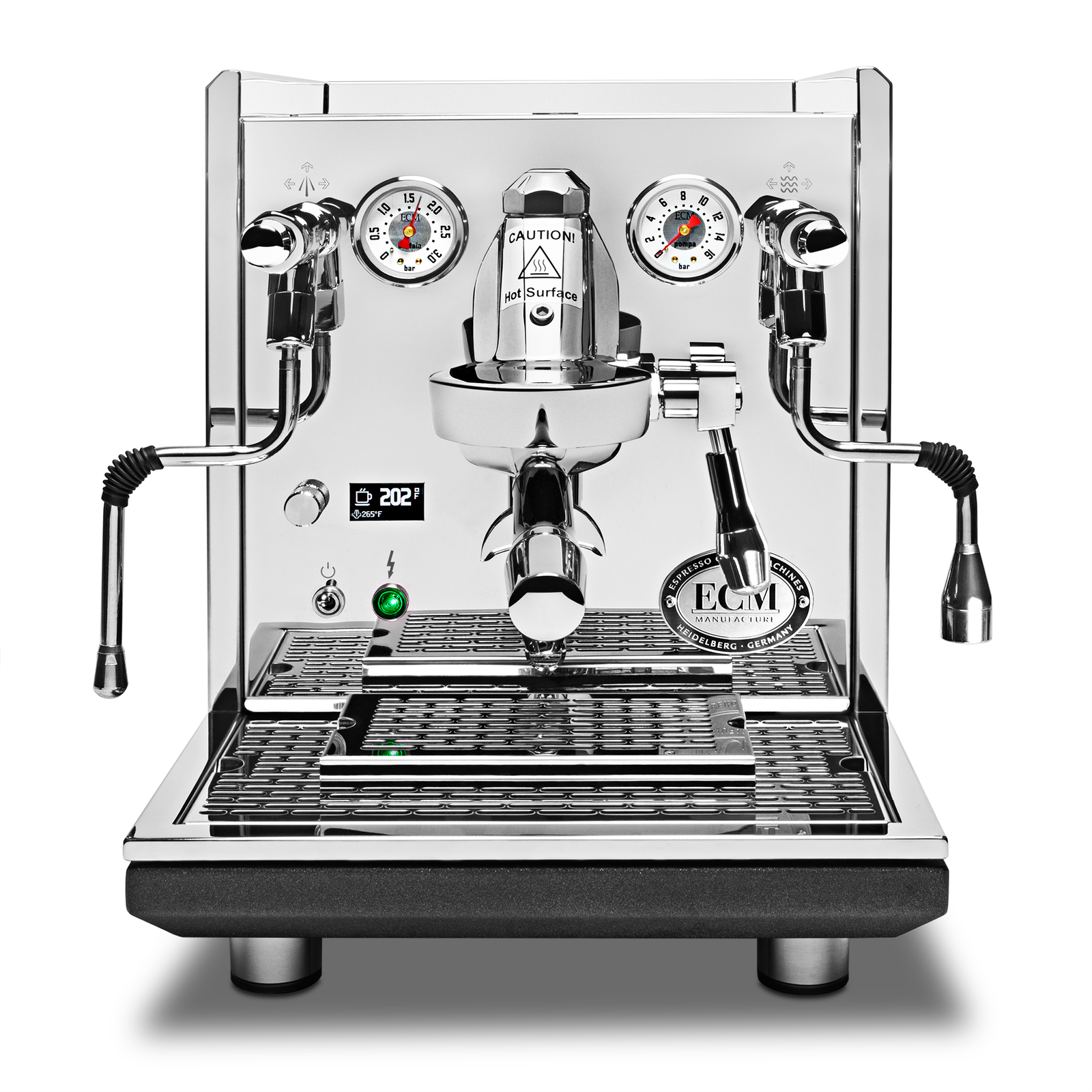
To steam milk, purge the wand, set its tip below the surface of cold milk, open the valve to draw in air, then sink the tip deeper so the milk spins into a whirlpool and heats to about 140 to 150°F (60 to 65°C). Tap and swirl the pitcher, then wipe and purge the wand.
This guide shows:
- How to steam milk step by step
- How to adjust the technique for a latte or a cappuccino
- How to froth milk on a machine that does it for you
The technique is the same on every steam wand, but the power behind it is not, as the machine-type section below shows. New to espresso? Start with how to use an espresso machine.
What do you need to steam milk?
- Cold milk. Breville starts with cold milk, and La Marzocco Home recommends milk straight from the fridge because it gives you more time before the milk overheats. JURA’s E8 manual calls a milk temperature of 4 to 8°C (about 39 to 46°F) the most important requirement for frothing.
- A stainless steel pitcher sized to the drink. Dalla Corte advises matching the pitcher to the beverage and notes that steaming gets harder to control when a pitcher is less than half full. Breville fills its jug up to the bottom of the spout.
- A damp cloth kept only for the wand.
How do you steam milk step by step?
- Purge the wand. Open the steam valve over the drip tray to clear condensed water. ECM’s Synchronika II manual says about 3 seconds.
- Position the tip. Tilt the pitcher slightly and place the tip just below the surface. Breville puts it about ½ inch (1.5 cm) into the milk.
- Stretch (add air). Open the valve and keep the tip right at the surface. La Marzocco Home says you should hear a gentle hiss, and that loud splattering or screaming means the tip is too high. De’Longhi warns not to let in so much air that you create large bubbles. Lower the pitcher slowly as the milk rises so the tip stays at the surface.
- Texture. Raise the pitcher so the tip sits a little deeper and the milk spins. De’Longhi describes this as immersing the wand below the surface to create a vortex. La Marzocco Home says this whirlpool folds the air into the milk.
- Stop at the right temperature. Breville and La Marzocco Home both give 140 to 150°F (60 to 65°C), which is about when the pitcher becomes too hot to hold. ECM’s Classika PID manual warns not to bring the milk to a boil, otherwise frothing will not be possible. La Marzocco Home adds that overheated milk tastes slightly burnt and acidic.
- Close the valve, then remove the pitcher. ECM’s manuals say to keep the tip under the surface while steam flows to avoid hot spray.
- Polish. Tap the pitcher to pop large bubbles and swirl until the milk looks glossy, like wet paint.
- Clean the wand right away. Purge it into the drip tray and wipe it with a damp cloth (see the cleaning section below).
How do you steam milk differently for a latte vs a cappuccino?
The motion is the same. What changes is how much air you add.
| Latte | Cappuccino | |
|---|---|---|
| Stretch | Short | Two to three times longer than a latte (Ringtons) |
| Milk in the pitcher | More | Less, because it expands about 40% (Ringtons) |
| Texture | Thin, glossy microfoam that pours like wet paint | Thicker, airier foam |
| Pour | Steady pour, suited to latte art | Low and from the side so the foam settles in (Ringtons) |
Ringtons, a UK tea and coffee roaster, fills the cappuccino jug to about one finger width below the spout and listens for a tearing-paper sound while air goes in.
What milk should you use?
- Whole dairy milk gives the richest, creamiest result, according to La Marzocco Home, which also says it steams and holds shape better than low-fat milk for latte art.
- Oat, soy and almond milk can steam well with practice (La Marzocco Home). Breville says not to heat non-dairy milk above 130°F (55°C), or it can separate or curdle.
How do you pour latte art?
Latte art starts with latte-textured milk: glossy, fluid and only lightly aerated. La Marzocco Home recommends the heart as the first pattern because it combines steaming, pitcher position, pour speed and the final cut-through:
- Tilt the cup and pour into the center of the espresso from about 7 cm (just under 3 inches) above the surface.
- When the cup is about a quarter full, tilt it toward the pitcher and drop the spout as close to the surface as you can without touching it.
- Pour a little faster and wiggle the pitcher gently side to side so the white milk spreads across the surface instead of sinking.
- Near the top, slow down, level the cup, lift the pitcher and pull a thin stream through the middle to form the point.
How does steam power differ by machine type?
A stronger wand heats milk faster, which leaves less time to stretch. ECM says the Synchronika II’s steam volume can prepare milk foam within a few seconds, and recommends a lower steam temperature at first while you learn. Its factory default is 128°C (262.4°F), adjustable up to 132°C. See our boiler comparison.
Single boiler
One boiler handles both jobs, so you brew first and then switch to steam.
- ECM Classika PID: cannot brew and steam at the same time. Its manual has you open the steam valve for about 5 seconds, twice, 20 seconds apart, to get drier steam, and refill the boiler afterward to bring it back to brewing temperature.
- Profitec GO: takes roughly a minute to move from brewing to steaming.
- ECM Casa V: uses a two-hole steam tip on an articulating wand.
Browse single boiler machines.
Heat exchanger
A heat exchanger machine brews and steams at the same time from a single boiler, and the boiler temperature setting decides how much steam you get.
- ECM Mechanika Slim PID: has three temperature presets (248, 255 and 262°F), and the highest gives extra steam power.
- Profitec Pro 500 PID: allows nearly continuous steaming with the boiler set to 256°F.
- ECM Mechanika Max: offers a steam priority mode with a cooling flush reminder.
- 969.Coffee Elba 3: needs a cooling flush between steaming and brewing.
Dual boiler
A dual boiler machine has separate brew and steam boilers, each regulated on its own, so you can set steam power without touching brew temperature.
- ECM Synchronika II and Profitec Drive: each pair a 2 L steam boiler with up to 2 bar of steam pressure.
- Profitec Pro 600: pairs a 1 L steam boiler with 2 bar.
- Rancilio Silvia Pro: a compact option with a 1.0 L steam boiler and a 4-hole steam tip.
- Profitec Pro 300: a compact option with a two-hole tip.
How do you froth milk without a steam wand?
A super-automatic does the frothing for you.
- JURA E8: makes one-touch cappuccinos, flat whites and latte macchiatos with its fine foam frother.
- JURA S8: has a switch for milk density.
- JURA GIGA 10: offers 10 milk temperature levels.
- JURA J8: blends syrup into the milk with its Sweet Foam System.
Compare models in our JURA comparison.
For capsule coffee, the Nespresso Vertuo by De’Longhi with Aeroccino includes an Aeroccino3 that makes hot milk foam, hot milk or cold froth.
How do you clean the steam wand?
- Every time: purge the wand into the drip tray and wipe it with a damp cloth. ECM’s manuals give both steps after every use. La Marzocco Home warns that dried milk can block the wand.
- Blocked tip: ECM’s Classika PID manual says to clear the holes carefully with a needle or paper clip. The nozzle can be unscrewed, but keep the small gasket behind it.
- JURA milk systems: the E8 prompts a milk system rinse after each milk drink and needs a milk system cleaning daily on any day you made milk drinks, using JURA milk system cleaner.
For the rest of the routine, see how to clean an espresso machine.
Frequently asked questions
What temperature should steamed milk be?
Breville and La Marzocco Home both give 140 to 150°F (60 to 65°C). Keep non-dairy milk below 130°F (55°C), per Breville.
Why are there big bubbles in my milk?
Too much air went in. La Marzocco Home says loud splattering means the tip is too high, and De’Longhi warns that letting in too much air creates excessively large bubbles. Sink the tip sooner, then tap and swirl the pitcher before pouring.
How do I froth milk for a cappuccino instead of a latte?
Use less milk and stretch longer. Ringtons adds air for two to three times as long as for a latte and expects the milk to grow by about 40%.
Sources
- Breville: Mocha recipe and milk steaming steps
- La Marzocco Home: How to steam milk with a home espresso machine
- La Marzocco Home: Pouring latte art
- La Marzocco Home: How to properly clean your espresso machine
- De’Longhi: How do I froth milk with my Dedica Maestro?
- ECM: Synchronika II user manual
- ECM: Classika PID user manual
- JURA: E8 instructions for use
- Dalla Corte: Picking the perfect pitcher
- Ringtons: How to make the perfect cappuccino