
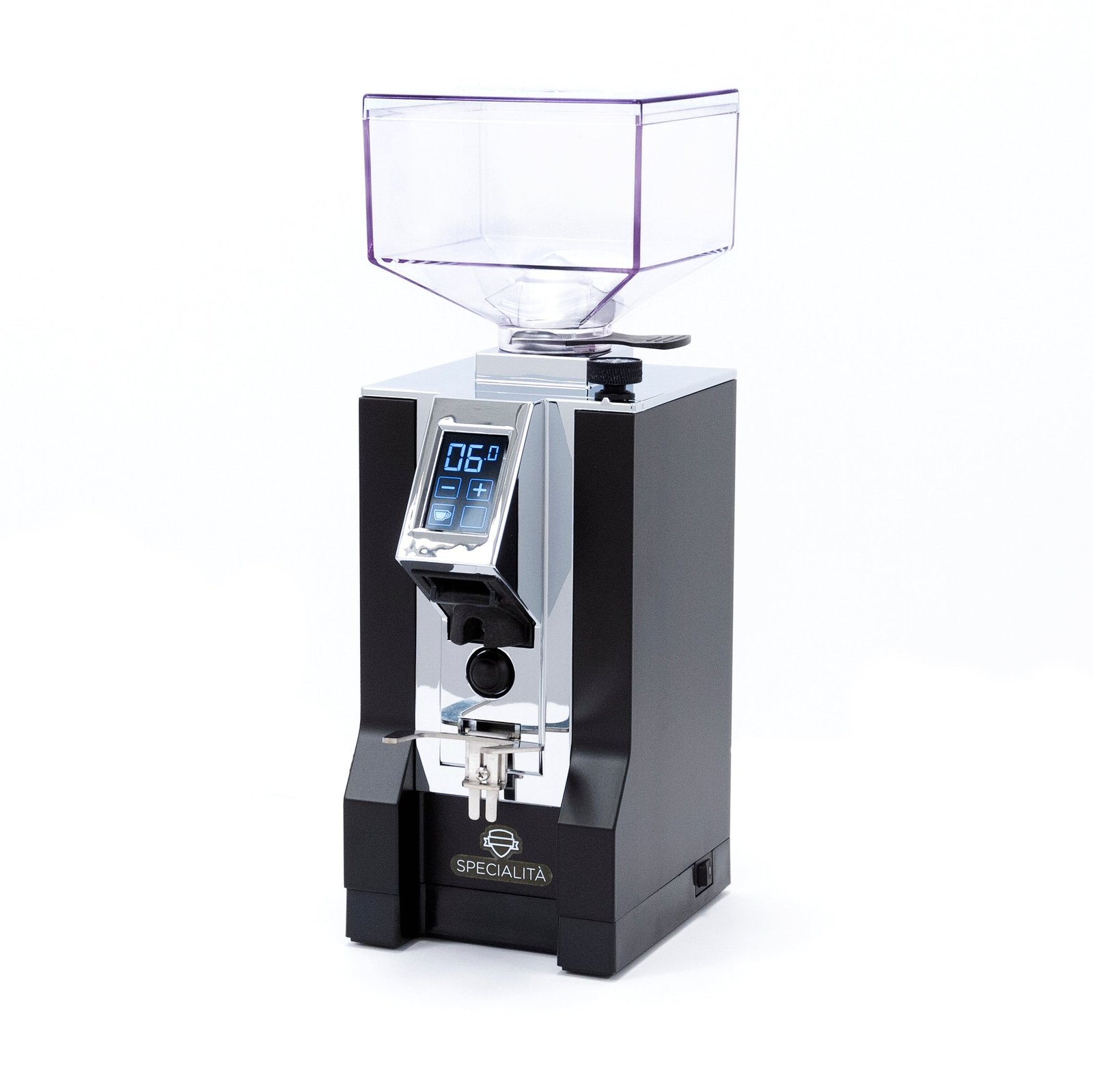
The right espresso grind size is very fine, but there is no single number that works on every grinder: it is whatever setting lets your dose of coffee reach your target yield in about 25 to 35 seconds. A common starting recipe is 18 g of ground coffee in and 36 g of espresso out, a 1:2 ratio. If the shot runs fast and tastes sour, grind finer; if it runs slow and tastes bitter, grind coarser.
Below is how dose, ratio, time and pressure fit together, a step-by-step way to dial in, and how stepless and stepped grinders differ when you make those small changes.
What is the right espresso grind size?
La Marzocco puts it simply: espresso needs a very fine, consistent grind, and a good shot won’t come from pre-ground coffee or from grinders without enough range at the fine end. Grind size is the main tool for controlling how fast water flows through the coffee puck. La Marzocco explains that a finer grind increases surface area and lowers the flow rate, so the shot takes longer.
That is why grind size is described by results rather than by a dial number. Dial numbers are specific to each grinder, and the same grinder needs a different setting for a new bag of coffee. Instead of chasing a number, fix your dose and yield and use the shot time to tell you which way to move the grinder.
How much coffee for espresso?
Your dose should match your filter basket. La Marzocco’s rule of thumb is to stay within about 1 to 2 grams of the basket’s rated size, and it describes 17 to 18 grams in a 17 gram basket as a standard dose. Weighing each dose on a scale is the easiest way to keep it consistent.
- Single basket: a smaller dose. The ECM Mechanika Max, for example, comes with a 7 g single basket.
- Double basket: the Mechanika Max’s double basket is rated at 14 g, while La Marzocco’s standard example is 17 to 18 g in a 17 g basket.
- Other sizes: some machines include more choice; the Profitec MOVE ships with single, double and triple baskets.
Pick one basket, weigh the dose that suits it, and keep that dose the same while you adjust the grind.
Espresso ratio: dose in, yield out
The espresso ratio compares the weight of dry coffee with the weight of liquid espresso in the cup. La Marzocco calls 1:2 (say, 18 g in and 36 g out) a great place to start, and suggests longer ratios for lighter roasts and shorter ones for darker, more developed roasts.
| Ratio | Example recipe | When to use it |
|---|---|---|
| 1:1 | 14 g in, 14 g out | Traditional ristretto; La Marzocco also suggests 1:1 to 1:1.5 for more developed roasts |
| 1:2 | 18 g in, 36 g out | The usual starting point |
| 1:2 to 1:2.5 | 18 g in, 36 to 45 g out | Lighter roasts |
| 1:3 | 7 g in, 21 g out | A longer, traditional Italian-style shot |
La Marzocco notes that adjusting the ratio can smooth out or bolden the strength of flavors, while a finer grind makes the espresso thicker and more distinct. Both La Marzocco and Baratza work by weight, so put a scale under the cup and stop the shot when it reaches your target.
Target shot time
Most guides land between about 25 and 35 seconds for a standard shot. La Marzocco gives 25 to 35 seconds as the typical target for reaching your ratio, and Baratza’s test recipe of 18 g in and 36 g out aims for 25 to 32 seconds from start to finish. Time is a guide, not the goal: if the shot tastes balanced a few seconds outside the range, trust your taste.
How to dial in espresso step by step
- Set your dose. Weigh the coffee for your basket and keep it the same for every test shot. Baratza’s first rule is to keep dose consistent while adjusting grind.
- Choose a target. Start at 1:2, for example 18 g in and 36 g out.
- Pull a shot and stop it at the target weight. Note the time.
- Read the result. Fast and sour or thin means grind finer. Slow and bitter or harsh means grind coarser.
- Change one thing at a time, in small increments. If you change grind and dose together, you will not know which one made the difference.
- Purge after each grind change. La Marzocco recommends grinding off 2 to 3 seconds’ worth of coffee so you are not brewing with grounds from the old setting.
- Taste once the time is in range, then fine-tune the ratio to taste.
- Out of range at the fine end? Baratza says calibration may help, and that increasing the dose by a few grams can also help.
For the full machine workflow, from tamping to steaming, see how to use an espresso machine.
Why 9 bar espresso is the reference
La Marzocco explains that early lever machines pressed water through the coffee with a spring, and that the average pressure of that action was found to be about 9 bar. It became the standard, and La Marzocco says every machine leaving its Florence factory is calibrated to brew at that pressure.
Pump labels can be confusing. Profitec explains that a vibration pump has an output of 15 bar, which can be reduced to 9 to 10 bar with an expansion valve. So a pump’s rated output and the brewing pressure are not the same number.
Pressure and grind work together. In La Marzocco’s 6-bar experiment, the lower pressure called for a finer grind and the shots took about 35 to 50 seconds. Some machines let you change brew pressure: the ECM Puristika has a front knob for roughly 8.5 to 12 bar, and the Profitec GO has an adjustable OPV under the cup tray. La Marzocco says its machines are pre-set to 9 bar, so there is typically no need to adjust; unless you are experimenting on purpose, dial in with the grinder instead.
Stepless vs stepped grind adjustment
Baratza defines a stepped grinder as having physical, defined limits between each setting, and a stepless grinder as completely smooth, with one setting flowing into the next. For espresso, Baratza notes that the perfect shot on a stepped grinder may lie between two settings, while stepless grinders suit the small changes espresso needs. The trade-off is repeatability: stepped settings are easy to track, and many stepless grinders have no markings, so record your setting.
Stepless grinders in our range
- Eureka Mignon Specialita and Eureka Mignon Perfetto: Eureka’s stepless micrometric adjustment. Eureka says its system repositions the lower burr, so cleaning does not lose the grind setting.
- LX Newton 55: stepless micrometric adjustment with programmable shot times.
- Mahlkonig X54: stepless; its listing says one full turn spans cold brew to espresso.
- Varia VS6: stepless in 5 micron increments, with notches on the hopper to count rotations back to a setting.
- Ceado E5SD: a stepless single dose grinder with bellows to push out retained grounds.
Stepped and macro/micro grinders
- Baratza Sette 270Wi: 270 settings across 230 to 950 microns. Baratza says Sette macro adjustment is stepped and micro adjustment is stepless.
- Baratza Vario+: 220 settings with macro and micro adjustment, for switching between espresso and coarser methods.
Burr geometry matters too; see flat burr vs conical burr, browse espresso grinders and single dose grinders, or read how to choose an espresso grinder.
Frequently asked questions
What grind size is espresso?
Very fine and consistent. The correct setting is the one that brings your dose to your target yield in about 25 to 35 seconds.
What is the best espresso ratio?
Start at 1:2, such as 18 g in and 36 g out. Go longer for light roasts and shorter for darker roasts, then adjust to taste.
How much coffee is in a double shot of espresso?
It depends on the basket. Match the dose to the basket’s rated size within 1 to 2 grams. The ECM Mechanika Max’s double basket is rated at 14 g, and La Marzocco uses 17 to 18 g in a 17 g basket as its standard example.
Is 9 bar or 15 bar better for espresso?
Nine bar is the brewing reference. A 15 bar figure can describe a vibration pump’s output, which Profitec says can be reduced to 9 to 10 bar with an expansion valve.
Why is my espresso running too fast?
The grind is usually too coarse for your dose. Grind finer in small steps, purge, and check that your dose matches the basket.
Sources
- La Marzocco Home: Basic espresso theory
- La Marzocco Home: The essential guide to mastering espresso at home
- La Marzocco Home: How to dial in your grinder for espresso
- La Marzocco Home: Dialing in a traditional espresso
- La Marzocco Home: Brewing espresso at 6-bar
- La Marzocco Home: Why buy a home espresso grinder?
- Baratza: Dialing in espresso
- Baratza: Stepped vs. stepless
- Eureka: Stepless micrometric regulation system
- Profitec: About us (vibration and rotary pumps)