
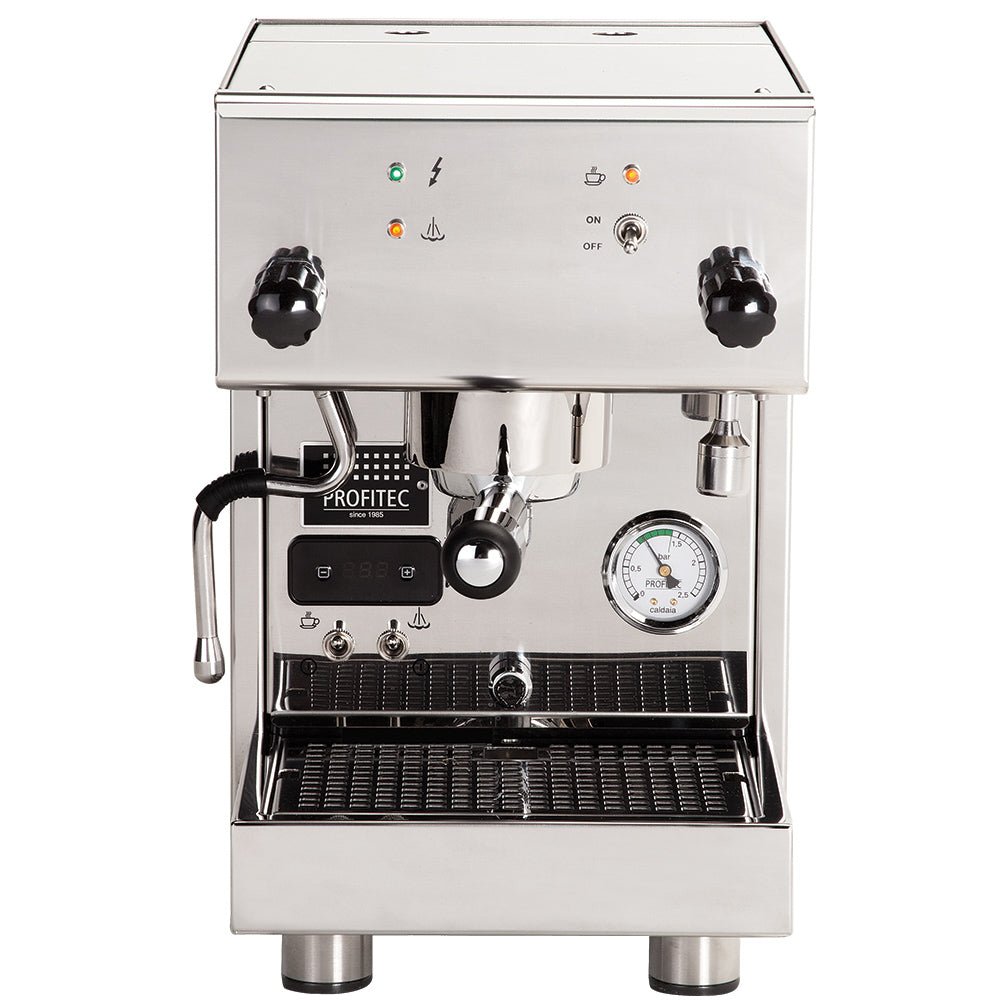
The best espresso machine for home is the one that matches the drinks you make and the budget you have. If you are ready to move past an entry-level appliance, a prosumer machine is the step up: a PID single boiler for mostly espresso, an E61 heat exchanger for regular milk drinks, or a dual boiler if you want to set brew temperature and steam on separate boilers. If you would rather not learn barista skills at all, a JURA super-automatic grinds, brews and froths at the touch of a button.
This guide is for buyers looking at that next tier. Every machine below is in our range, and each pick is explained by what its listing states, not by a lab test. Browse the full range in semi-automatic espresso machines.
What makes a prosumer espresso machine different?
“Prosumer” is shorthand for home machines built with parts and layouts borrowed from café equipment. These are the features worth comparing.
- Boiler type. ECM describes three layouts. In a single boiler, brew water and steam are heated in the same circuit. A heat exchanger uses a thermosyphon to circulate water through the brew group, and coffee is always brewed with fresh water. A dual boiler lets you set brew and steam temperatures independently. Profitec notes that a dual boiler is more temperature stable than a heat exchanger. Our boiler comparison covers the trade-offs.
- PID temperature control. Older machines used pressurestats that switch the heater fully on or off, so the temperature drifts past the set point. La Marzocco explains that a PID keeps modelling boiler temperature and varies the heater’s on and off time for much finer control. More in our PID espresso machine guide.
- E61 group. Profitec describes the E61 as the first heat exchanger machine, using fresh water instead of boiler water, with a brew head that pre-infuses the coffee before full pressure. See what an E61 group head is.
- 58 mm portafilter. Barista Magazine calls 58 mm the commercial standard, which matters when you buy aftermarket baskets and tampers. Check each listing; the Rancilio Silvia Pro, for example, ships with a 58 mm tamper.
- Pump. ECM explains that a vibratory pump moves water with a rapidly vibrating piston, while a rotary pump uses a spinning rotor and vanes for consistent pressure. Profitec adds that a vibration pump’s 15 bar output is reduced to 9 to 10 bar with an expansion valve, and that the rotary pump is almost noiseless. Several rotary-pump models in our range can also be plumbed into a water line.
- A real grinder. La Marzocco notes that espresso needs a very fine, consistent grind and won’t come from pre-ground coffee. Budget for one with our espresso grinder guide.
Best espresso machine for home by budget
These bands come from the list prices of new semi-automatic machines on our site, which change over time.
| Budget | New semi-automatics in our range | What you typically get |
|---|---|---|
| Under $1,500 | 3, from about $980 to $1,450 | Compact single boilers and one E61 heat exchanger |
| $1,500 to $2,500 | 14, from about $1,600 to $2,400 | PID single boilers, PID heat exchangers, compact and value dual boilers |
| Over $2,500 | 11, from about $2,600 to $3,700 | Dual boilers with rotary pumps, flow control, volumetric dosing, a lever |
JURA super-automatics in our range run from about $1,200 to $10,000 at list price.
Best espresso machine under $1,500
The ECM Casa V is the entry point of our new semi-automatic range: a 0.4 liter brass boiler, a brew pressure gauge, an accessible overpressure valve and an articulating steam wand with a two-hole tip. Its listing does not mention a PID. The Profitec GO adds PID control and a shot timer to a similar 0.4 liter single boiler, and its listing puts the brew-to-steam switch at about a minute. For an E61 group on a budget, the 969.Coffee Elba 3 is a 9-inch-wide heat exchanger with a 1.5 L boiler, though its listing notes it needs a cooling flush between steaming and brewing.
Shopping for the best espresso machine under $1,000? Start with the Casa V, the entry point of our new semi-automatic range, and also check our refurbished espresso machines.
$1,500 to $2,500: the prosumer sweet spot
This band holds half of our semi-automatic range. Single boiler buyers get the ECM Classika PID (E61 group, PID for brew and steam). Heat exchanger buyers can choose the compact Profitec Pro 400, the Profitec Pro 500 PID or the ECM Mechanika Max. Dual boilers start here too, with the Profitec Pro 300, Rancilio Silvia Pro, Profitec MOVE and Profitec Pro 600.
High end espresso machine: over $2,500
A high end espresso machine in our range is mostly about convenience and control, not a different way of brewing. The ECM Synchronika II has a heated E61 group its listing says reaches brewing temperature in about 6.5 minutes, plus a plumbable rotary pump. The Profitec Drive adds E61 flow control and programmable pre-infusion. The Profitec RIDE heats both boilers at the same time, and the ECM Elektronika II Profi has programmable volumetric brew buttons.
Best home espresso machine by need
- Mostly espresso: the Profitec GO or ECM Classika PID. If you never steam milk, the ECM Puristika is an espresso-only E61 machine with a PID and a front brew pressure knob.
- Milk drinks on an E61 heat exchanger: the Profitec Pro 500 PID, whose listing says routine cooling flushes are no longer needed in most situations.
- Dual boiler on a budget: the Profitec Pro 300, which its listing pitches to buyers who want value, with a Gicar PID and a switchable steam boiler. Our dual boiler picks go deeper.
- Small kitchen: the Profitec Pro 400 (9 inches wide), the ECM Mechanika VI Slim (under 10 inches), the Rancilio Silvia Pro (9.8 inches, dual boiler) or the Profitec MOVE, a compact dual boiler.
- Plumbed into a water line: the ECM Mechanika Max, ECM Technika V Profi PID, ECM Synchronika II or Profitec Drive, all with rotary pumps.
- Hands-on lever brewing: the Profitec Pro 800 Lever, with low-pressure pre-infusion and a Gicar PID.
- No barista skills needed: a JURA. The JURA E8 lists 17 one-touch coffee and milk drinks, the JURA S8 15 specialties on a touchscreen, and the JURA ENA 4 four specialties for espresso purists. Compare them in our JURA comparison or browse super-automatic espresso machines.
How to choose a prosumer machine
- Count your milk drinks. One or two a day suits a single boiler; steady milk drinks favor a heat exchanger or a dual boiler.
- Measure your counter, including clearance above the machine for filling the reservoir.
- Decide on water. If you want to plumb in, shortlist rotary-pump models whose listings say they can be connected to a water line.
- Check warm-up. Listings range from 5 to 7 minutes on the small ECM Casa V to about 11 minutes on the Profitec Drive; models with scheduled wake-up timers can be ready when you are.
- Keep money and counter space for a grinder. The ECM Classika PID listing, for example, notes that its small footprint leaves room for a good grinder. Browse single boiler espresso machines.
Frequently asked questions
What is a prosumer espresso machine?
A home espresso machine built with café-style parts: a single, heat exchanger or dual boiler layout, often a PID, an E61 or similar brew group, a commercial-size portafilter and, on some models, a rotary pump.
Is a high end espresso machine worth it?
It depends on which extras you will use. Machines above $2,500 in our range add things like plumbing, scheduled heat-up, flow control, volumetric buttons or lever brewing. If you make one espresso a day, a PID single boiler and a good grinder may serve you just as well.
What is the best espresso machine under $1,000?
Look first at the ECM Casa V, the entry point of our new semi-automatic range, and compare its current price. Refurbished machines can be another route to prosumer parts at a lower list price.
Which is best for home: single boiler, heat exchanger or dual boiler?
A single boiler suits espresso-first drinkers, a heat exchanger suits regular milk drinks with some technique, and a dual boiler gives separate control of brew and steam temperatures.
Do I need a separate grinder?
For any semi-automatic, yes. JURA super-automatics have a built-in grinder, so they do not need one.