
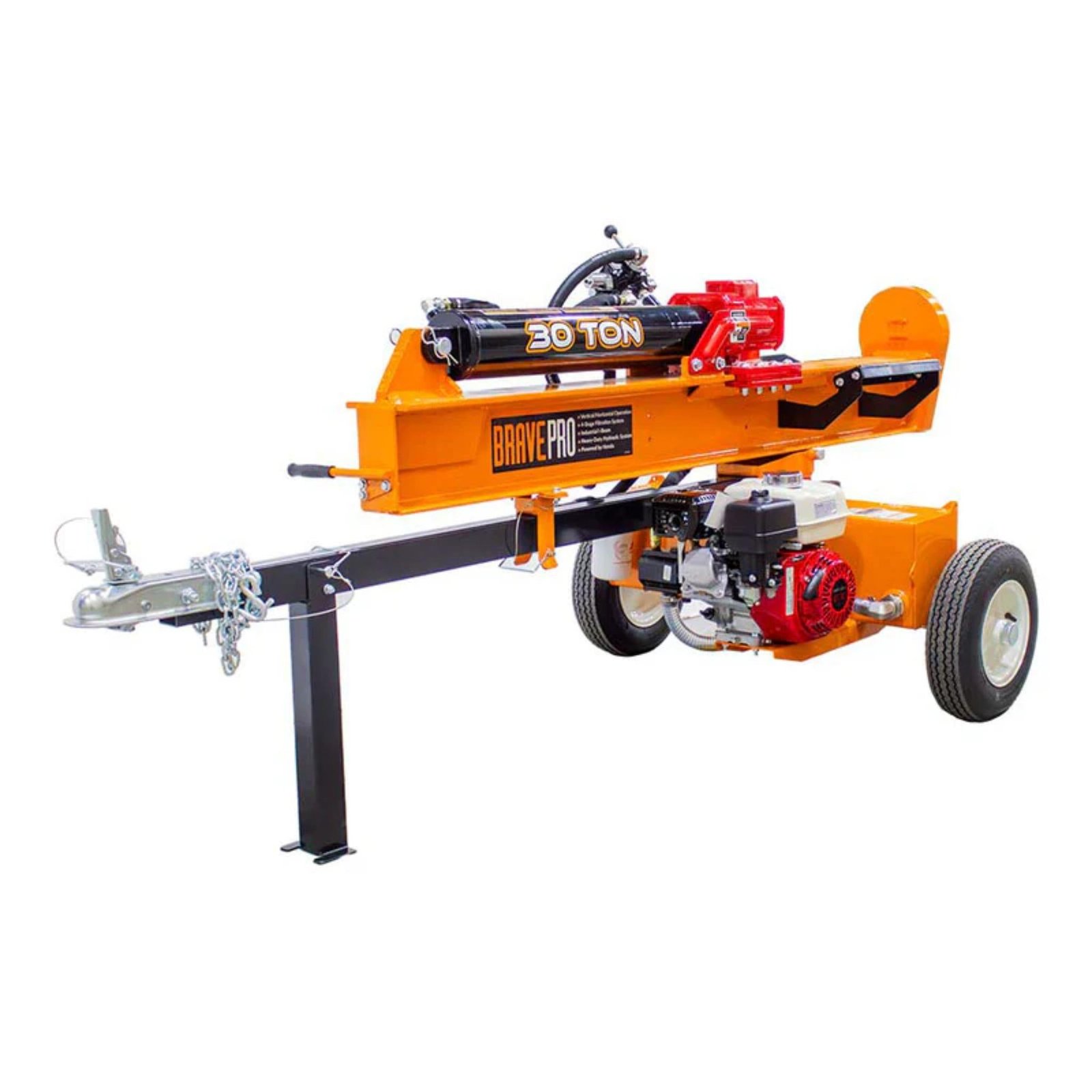
The best log splitter is the one whose splitting force matches the hardest, largest and knottiest wood you expect to split, with a little headroom for the logs you will get in future years. For most firewood, that means choosing tonnage by wood species and moisture first and log diameter second, then picking an engine grade that suits how many hours you will run it. Just as important: a hydraulic splitter can crush or amputate fingers, so plan to use it exactly as the operator’s manual describes.
Below: how to size a splitter, horizontal vs vertical splitting, the five Brave tow-behind models in our log splitters category, and safe operating steps.
What size log splitter do I need?
Log splitters are rated in tons of splitting force. Champion Power Equipment, a splitter manufacturer, advises that the hardest wood you split is the basis for the tonnage estimate, and suggests thinking ahead: you might only split small pine today but bigger logs later. Three things push the force you need upward:
- Species. Dense or interlocked-grain wood resists splitting. University of Illinois Extension notes that osage orange and black locust are harder to split than other hardwoods. Purdue Extension describes elm as commonly having interlocked grain that makes it very difficult to split.
- Moisture. Champion notes that green wood is challenging to split and needs more power to split efficiently.
- Knots and diameter. Penn State Extension notes that motorized splitters work well when splitting knotty or tough wood. Champion’s advice to plan for 12-inch or bigger logs, even if you only split 6-inch pine today, reflects that diameter matters as well.
We did not find a neutral, published chart that converts log diameter into tons, so size for your worst wood: if you regularly see wide, knotty or green hardwood, step up in tonnage; if you split mostly straight-grained, seasoned wood of moderate size, a lower-tonnage machine is easier to justify.
Let split wood season before you burn it
Whatever you split, give it time to dry. Illinois Extension recommends a moisture content below 20 percent before burning and says that usually takes at least six to nine months of drying after cutting fresh wood. Burning wet wood produces more smoke and less heat, and adds to creosote buildup in the chimney.
Horizontal vs vertical log splitters
All five Brave models in our range split in both positions, switched with a lift handle.
- Horizontal is the everyday mode: you lift a round onto the beam and the ram pushes it into the wedge. It suits logs you can lift comfortably.
- Vertical lets you roll a heavy round onto the end plate instead of lifting it. Champion notes that switching from horizontal to vertical operation makes heavier logs easier to load. The Cub Cadet LS 25 CC operator’s manual says that in the vertical position you stand in front of the splitter, stabilize the log before moving the control, and shim extra large or uneven logs with wooden shims or split wood.
Choosing the best log splitter: Brave 24, 30 and 37 ton models compared
Every model below uses an industrial I-beam frame, a four-stage hydraulic filtration system, log cradles, a log dislodger and a 2-inch ball hitch with safety chains and highway-rated tires. Specifications are as Brave lists them; a dash means the figure is not stated in the listing.
| Model | Force | Engine | Cycle time | Hydraulics | Other stated specs |
|---|---|---|---|---|---|
| Brave 24-Ton with Honda GC160 (VH1724GC) | 24 tons | Honda GC160, 160cc | 13 sec | 11 GPM two-stage pump, 3,500 PSI, 8-gallon hydraulic tank | 16-inch diameter, 25-inch log capacity |
| Brave 24-Ton with Honda GX160 (VH1724GX) | 24 tons (48,000 lb) | Honda GX160, 160cc | 13 sec | 4 x 24-inch cylinder, 11 GPM two-stage pump, 3,500 PSI | 8-inch high-carbon steel wedge |
| Brave 30-Ton with Honda GC190 | 30 tons | Honda GC190 | – | Two-stage pump | O-ring fittings, manual storage tube |
| Brave 30-Ton with Honda GX200 (VH1730GX) | 30 tons | Honda GX200 | 14 sec | 5 x 24-inch cylinder, 13 GPM pump | 8-inch wedge, 25-inch log opening |
| Brave 37-Ton with Honda GX270 (VH1737GX) | 37 tons | Honda GX270, 270cc | 14 sec | 5 x 24-inch cylinder, two-stage pump | 550 lb dry weight |
List prices on our site for these five splitters run from about $2,350 to $3,100, and prices change.
GC or GX engine?
Each tonnage comes with a choice of Honda engine family. Honda markets the GC160/GC190 as premium residential power, while it lists commercial lawn and garden, construction and agricultural equipment among the applications for both the GX120/GX160/GX200 and the GX240/GX270 engines. If you split a few cords a year for your own stove, a GC engine fits the job; if the machine will run long days, for a firewood business or a crew, the GX versions are built for that kind of use.
Which Brave splitter fits your wood?
- Homeowner with mostly straight-grained wood: the 24-ton GC160, with a 13-second cycle and residential-class engine.
- Heavy homeowner use: the 24-ton GX160 keeps the same force and cycle time with a GX engine.
- Large, knotty or green hardwood: step up to 30 tons with the GC190 or the GX200, which pairs a 5 x 24-inch cylinder with a 13 GPM pump.
- Professional and rental use: the 37-ton GX270 has the highest splitting force in our range, and Brave positions it for professional users and rental operations.
More equipment from this maker is on our Brave brand page.
How to use a log splitter safely
Always follow the manual for your machine. The steps below summarize the safe operation practices in a manufacturer’s log splitter manual (Cub Cadet LS 25 CC) and Purdue University’s farm safety guidance.
- Learn the controls first. Read the manual and know how to stop the machine quickly. The Cub Cadet manual says never to let children under 16 operate a log splitter.
- Dress for it. Wear safety glasses or goggles and safety shoes or heavy boots, and no jewelry or loose clothing. Purdue’s guidance adds gloves, hearing protection, non-slip shoes and trim-fitting clothes.
- Set up on firm ground. Place the splitter on flat, dry, solid ground, block the wheels and lock the beam in the horizontal or vertical position. Work in daylight or good artificial light.
- One operator only. The manual notes that many accidents happen when more than one person operates the machine. Keep bystanders, children and pets at least 10 feet away, and do not activate the control until a helper stacking wood is at least 10 feet from the machine.
- Load safely. Cut logs with square ends. Split one log at a time. Place your hands on the sides of the log, never on the ends, and never steady a log with your foot.
- Get your hand out before the wedge bites. If you steady a log, remove your hand when the wedge just contacts it, and keep fingers away from cracks that open during the split; they can close suddenly.
- Treat hydraulics with respect. Fluid escaping from a pinhole under pressure can penetrate skin. Never check for leaks with your hand; pass a piece of cardboard or wood over the suspected spot while wearing gloves and safety glasses, and see a doctor immediately if fluid is injected. Do not run the machine with damaged hoses, and do not adjust the factory relief valve.
- Keep the area clear. Move split wood away from your feet, never leave the machine running unattended, and never move it while the engine is running.
- Fuel and tow with care. Never refuel indoors or while the engine is hot. Before towing on public roads, check federal, state and local vehicle requirements. Brave rates the 24-ton models for towing at up to 45 MPH.
Frequently asked questions
What size log splitter do I need for firewood?
Size it for the hardest wood you split. Dense species such as osage orange and black locust, interlocked-grain wood such as elm, green wood and knotty rounds all need more force. If that describes much of your wood, look at the 30- or 37-ton models; for moderate, straight-grained wood, the 24-ton models are the entry point in our range.
Is it easier to split green or seasoned wood?
Seasoned wood is easier on the machine: Champion notes that green wood is harder to split and needs more power. If you split green wood, size the splitter for it, and remember the wood still has to dry. Illinois Extension says firewood usually needs six to nine months of drying to get below 20 percent moisture.
How far should people stand from a log splitter?
The Cub Cadet manual specifies at least 10 feet for bystanders, children, pets and helpers. Only the operator should be at the controls.
Can I tow a log splitter on the road?
The Brave models have a 2-inch ball hitch, safety chains and highway-rated tires, but road towing rules vary. Check your state and local requirements before towing.
Sources
- Champion Power Equipment: Log Splitters, Reliable and Efficient Wood Splitting Technology
- Cub Cadet LS 25 CC Log Splitter Operator’s Manual (manufacturer PDF)
- Purdue University, Indiana Rural Safety and Health Council: Preventing Injuries Getting Firewood
- Penn State Extension: Heating with Wood, An Introduction
- University of Illinois Extension: Firewood
- University of Illinois Extension: Firewood Burning Safety
- Purdue Extension: Hardwood Lumber and Veneer Series, Elm (PDF)
- Honda Engines: GC160/GC190
- Honda Engines: GX120/GX160/GX200
- Honda Engines: GX240/GX270