
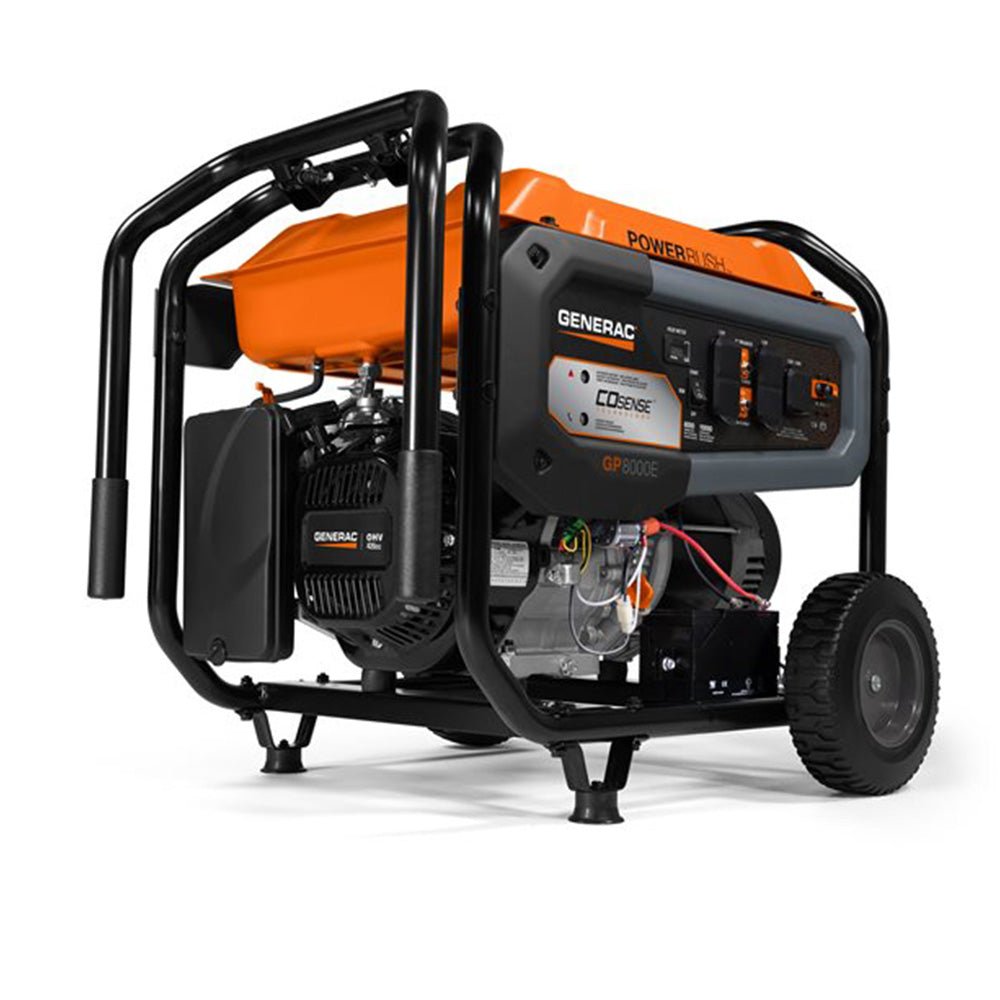
A generator usually won’t start because of a closed fuel valve, stale gasoline, low oil tripping the low-oil shutdown, the wrong choke setting, a bad spark plug or a weak starter battery. Generac calls old fuel left in the fuel system the most common cause. Work through the checklist in order, outdoors, with nothing plugged in.
When a generator won’t start, the cause is usually one of a few simple things:
- A closed fuel valve
- Stale gasoline
- Low oil tripping the low-oil shutdown
- The wrong choke setting
- A bad spark plug
- A weak starter battery
Generac calls old fuel left in the fuel system the most common cause of startup problems. Work through the checklist below in order, outdoors and with nothing plugged in, before you suspect anything more serious.
These are owner-level checks from Generac, Honda and Champion support pages and owner’s manuals, and your own manual comes first. Anything deeper, such as carburetor, governor or valve work, wiring or a suspected faulty sensor, belongs with an authorized service dealer.
What safety steps should I take before troubleshooting?
- Troubleshoot outdoors only. The CPSC says never to operate a portable generator inside a home, garage, basement, crawlspace, shed or other enclosed space, and that opening doors or windows will not provide enough ventilation. That includes test starts.
- Unplug every load. Champion’s manual says never to start or stop the generator with electrical devices plugged in or turned on.
- Put it on a flat, level surface. Champion points out that the low-oil sensor can stop the engine when the unit is not level.
- Wet weather: never move the generator inside to keep it dry. See can you run a generator in the rain for the safe options.
Why won’t my generator start?
- Fuel valve and engine switch. The first lines of Honda’s “engine will not start” table are a fuel valve left OFF and an engine switch left OFF, and Generac lists a closed fuel shut-off too. On a dual fuel model, check that the fuel selector is set to the fuel you are using.
- Fuel level and fuel age. Check the tank is not empty. Generac adds that running with less than a quarter tank can cause fuel delivery problems. Honda warns that fuel in the carburetor goes stale sooner than fuel in the tank, and that stabilizer will not restore fuel that is already stale. The fix in every manufacturer’s table is the same: drain old or water-contaminated fuel and refill with fresh gasoline.
- Oil level and the low-oil shutdown. Honda’s manual says that if the engine stops or the Oil Alert light comes on, check the oil level before troubleshooting anything else, then turn the engine switch OFF and restart. Check it on level ground and do not overfill. The right grade is covered in our generator oil type guide.
- Choke. A cold engine needs the choke on, and too much choke floods it. Champion’s 5500 W dual fuel manual says to keep the choke on for only one pull, then move it to RUN for up to three pulls. For a flooded engine, Champion says to let it stand for 10 minutes, while Generac suggests about 30 minutes. Honda’s fix for a plug wet with fuel is to dry and reinstall it.
- Spark plug and plug wire. Make sure the wire is pushed firmly onto the plug. Generac reads the plug as a clue: wet points to flooding, dry means fuel is not reaching the cylinder, so recheck the fuel supply and valve. Gap or replace a fouled plug to the spec in your manual. A dirty air filter is also on Generac’s no-start list.
- Battery on electric start models. Generac says clicking or no sound usually means a dead or low battery or corroded terminals.
- Charge it
- Clean and tighten the connections
- Try the recoil
If the recoil works, the fault is in the electric starting system. Generac notes its fuel-injected portables need at least 10 volts to start, even on the recoil. The Generac GP8000E has a plug-in charger jack to keep its battery topped up, the DuroMax XP13000HXT has a battery switch worth checking, and the i-Monitor on the Honda EU7000iS displays battery voltage.
- Propane. Champion’s propane start procedure is:
- Fuel selector to LPG
- Fully open the valve on the LPG cylinder
- Turn the generator’s LPG valve on
- Start with the choke
Generac’s GP Series manual says to turn the LP tank valve on and check the connections with soapy water. Growing bubbles mean a leak that must be fixed before use, and Generac sends you to a dealer for it.
Why does my generator start and then shut off?
If the engine fires and dies within seconds, Generac’s quick reference points to two causes: low oil or a CO shutdown. Check the oil first, then the CO indicator if your generator has one:
- Generac COsense: a blinking red light means it shut down because carbon monoxide was building up. Generac says to move the generator to an open area outside, far from windows, doors and vents. A blinking yellow light means a system fault, and repeated faults go to a dealer.
- Honda CO-MINDER: Honda says to move the generator to fresh air, away from other CO sources such as another generator, then press the reset button and restart. If the fault light keeps returning, do not restart more than two times, and consult a Honda dealer.
A CO shutdown is a warning, not a glitch to reset around: Generac notes that another generator’s exhaust or wind blowing exhaust toward the sensor can trigger it.
Why is my generator surging or hunting?
Generator surging, a regular rise and fall in engine speed, usually traces back to fuel, air or choke. Generac’s troubleshooting guide lists these causes:
- A choke left on after warm-up or opened too soon (hold it halfway until the engine runs smoothly)
- Stale or low fuel
- Debris in the fuel supply or inline filter
- A dirty air filter
- A bad spark plug
Champion’s table adds a dirty fuel valve. A lean carburetor or governor fault goes to the manufacturer’s service network, not DIY adjustment. Some speed change is normal: Generac says speed changes during startup and load changes are expected, and inverter generators vary engine speed with the load by design (Honda calls this Eco Throttle).
How do I prevent carbon monoxide poisoning from a generator?
A February 2026 CPSC release says an average of nearly 100 people die in the U.S. each year from CO poisoning caused by portable generators, and that exposed people may become unconscious before they notice nausea, dizziness or weakness. Its rules:
- Run portable generators outside only, at least 20 feet from the house, and never on a porch or in a carport.
- Point the exhaust away from your home and the entrances of other buildings.
- Install battery-operated CO alarms, or alarms with battery backup, on each level of the home and outside separate sleeping areas. Test them monthly. If one sounds, get outside immediately and call 911.
- Choose a generator with a CO shut-off safety feature.
Several models in our portable generators range have one: the Honda EU2200i and Honda EU3000iS (CO-MINDER), the Generac GP Series 12,500 W tri-fuel (COsense), the DuroMax XP13000HXT (CO sensor shutdown) and the DeWalt DXGNR6500 (CO Protect). Generac states that COsense is not a substitute for an indoor CO alarm, so you still need alarms in the house.
Why won’t my home standby generator start?
Generac’s outage troubleshooting guide limits owner steps to a few checks, and only if you are comfortable doing them:
- Confirm the fuel shutoff valve is on and propane is adequate
- Clear the alarm and return the unit to AUTO
- Check the oil on a low-oil-pressure alarm without overfilling
- On a low-battery alarm, allow a full 24-hour charge cycle in AUTO
If it still will not start, starts hard or runs rough, press OFF and call a Generac dealer. Compare units on our standby generators page.
When should I call a dealer?
The manufacturers list these as dealer jobs:
- Carburetor adjustment or a rich or lean mixture
- Governor or valve problems
- Lost compression
- A restricted fuel filter or ignition malfunction
- Damaged wiring or a faulty starter
- A suspected faulty oil pressure switch or CO sensor, including one nearing the end of its life
Routine care prevents most no-start problems. Our generator maintenance schedule covers the intervals, and Generac maintenance kits bundle the filters and plugs for a service.
Frequently asked questions
Why won’t my generator start after sitting all winter?
Stale fuel is the most likely reason. Drain the old gasoline, refill with fresh fuel and check the oil and battery. If stale fuel has gummed up the fuel system, Honda says the carburetor and other parts may need servicing or replacement, which is a dealer job.
Why does my generator start and then shut off?
Generac lists low oil and a CO shutdown as the causes. Check the oil on level ground, then look for a blinking CO light. After a CO shutdown, move the generator to open air away from the house before restarting.
Can I bypass the low-oil or CO shutoff to get the generator running?
No. These systems protect the engine and the people around it. Add oil to the correct level, or move the generator to a safe spot outdoors. If a CO sensor keeps faulting, Generac and Honda both say to have a dealer check it.
Sources
- Generac: Portable generator troubleshooting guide
- Generac: Portable generator troubleshooting quick reference guide
- Generac: GP Series multi-fuel portable generator owner’s manual
- Generac: Troubleshooting guide for home standby generators during an outage
- Honda: EU3000is generator owner’s manual
- Honda Power Equipment: Avoiding fuel-related problems
- Champion: 5500W dual fuel portable generator operator’s manual (model 100231)
- U.S. CPSC: Winter storm may knock out power, CPSC warns of deadly carbon monoxide and fire risks (2026)