
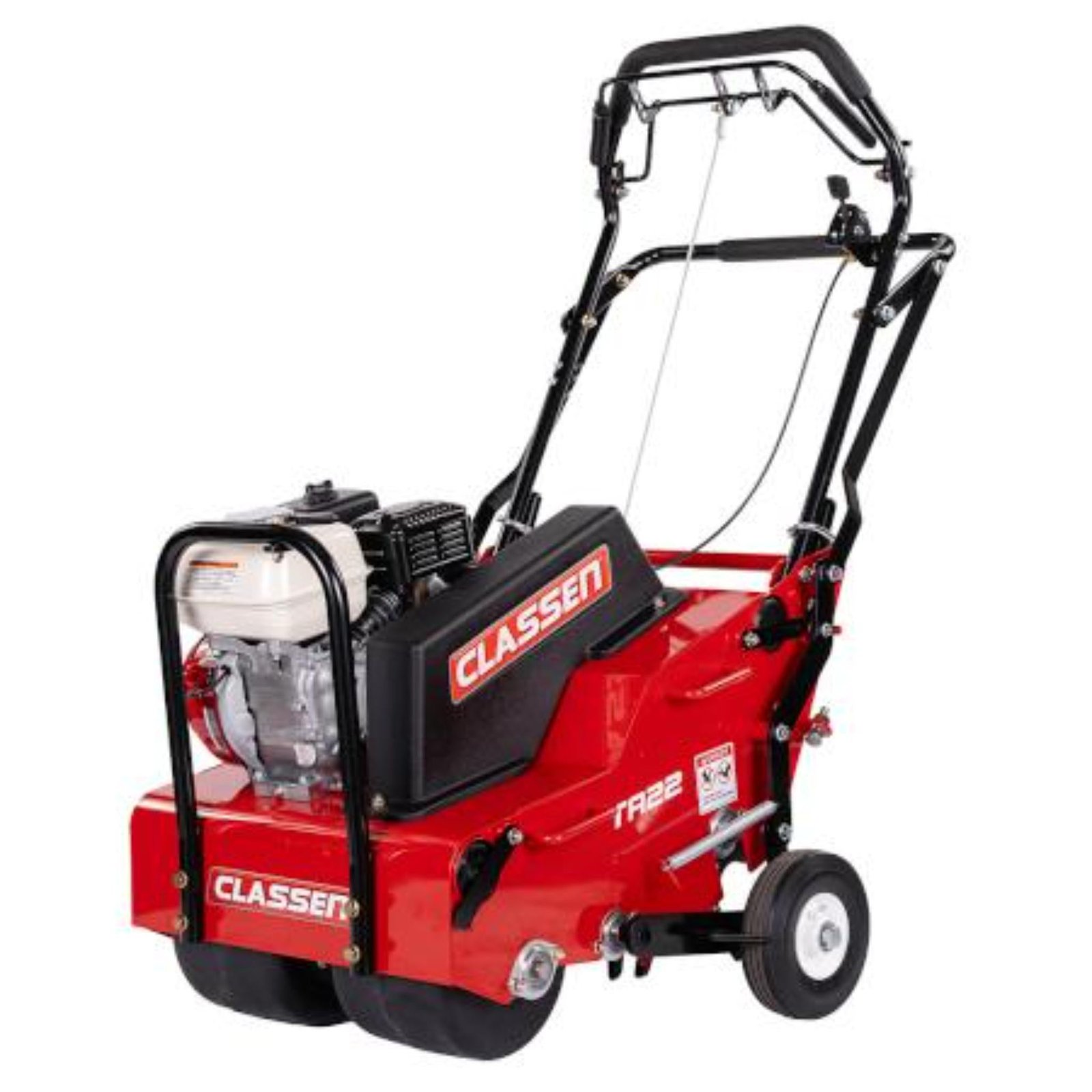
Core aeration pulls small plugs of soil out of a lawn with hollow tines so air, water and nutrients can reach the roots. It relieves soil compaction, helps control thatch and encourages deeper roots. Do it when the grass is actively growing and the soil is moist but not wet: early fall or spring for cool-season lawns, late spring through midsummer for warm-season lawns.
This guide explains what core aeration does, when to aerate, how to run a walk-behind core aerator, how aeration differs from dethatching, and how to follow up with seed. You can compare the machines we carry on our lawn aerators page.
What core aeration does
Kansas State University Research and Extension points out that roots make up about 90 percent of the grass plant and need a steady supply of oxygen. Compaction squeezes air out of the soil, and most of it happens in the top 2 inches. Foot traffic, play, parked cars and construction equipment are common causes. K-State lists these benefits of aeration:
- It breaks up or removes thatch.
- It improves infiltration of water and nutrients.
- It increases the oxygen supply to roots and lets carbon dioxide escape.
- It encourages new and deeper root growth, and it reduces runoff and puddling.
Core aeration is not the same as spiking. Solid spikes push soil sideways, which compacts the walls of the hole, so the benefit is short-lived. Hollow tines actually remove soil, and K-State calls that the most effective aeration method. Results build over time. K-State notes that it takes three consecutive years of regular aeration for a yard to get the full effect.
Core Aerator vs Spike Aerator: Which Should You Choose?
When comparing a core aerator vs spike aerator, look at what the tines do to the soil. A core aerator extracts plugs; a spike aerator punctures the ground without removing soil. Both leave holes, but that difference matters when your goal is to relieve compaction.
Choose hollow tines for compacted lawns
Removing a plug creates room for surrounding soil and roots to expand. Kansas State University Research and Extension identifies core aeration as the most effective method and explains that solid spikes push soil toward the sides of each hole, compacting that area again. For a lawn affected by repeated foot traffic or heavy clay soil, hollow tines are the stronger choice for addressing compaction.
Understand the trade-off with spikes
Spiking usually costs less and the turf recovers faster because no soil is extracted. However, K-State describes its effects as short-lived. Fewer visible plugs do not mean better compaction relief. Iowa State University Extension specifically recommends core aerators and advises avoiding spike devices that compact soil as they punch holes. If lasting relief is your priority, choose equipment that actually removes cores.
Check the machine before buying or renting
Ask whether the machine uses hollow coring tines or solid spikes. Our Classen TA18AH and Classen TA22H are core aerators; use the model comparison below to match width, steering and transport needs to your property. For occasional homeowner use, Iowa State notes that core aerators are often available from rental agencies.
Whichever machine you select, judge the work by the cores it pulls and the coverage achieved. Iowa State recommends moist soil, avoiding dry or wet conditions, and making several passes when needed. Follow the grass-specific timing and preparation guidance below so the lawn can recover; buying a larger machine does not replace correct operating conditions.
When to aerate a lawn
The rule is simple: aerate when the grass is growing strongly enough to fill the holes. K-State recommends allowing at least four weeks of good growing weather after aerating.
| Lawn type | Common grasses | Recommended window |
|---|---|---|
| Cool-season | Kentucky bluegrass, tall fescue, ryegrass | September, or March to April (K-State); September and April (Iowa State) |
| Warm-season | Bermudagrass, zoysiagrass, buffalograss | Late May through July (K-State) |
Colorado State University Extension says the lawn can be aerated anytime the ground isn’t frozen, but advises avoiding extremely hot, dry conditions. Early fall is a strong choice for cool-season lawns because it lines up with the best time to overseed.
How often depends on soil and use. Iowa State recommends twice a year for heavily used lawns on clay soil and once a year for established lawns on well-drained soil.
Get the soil moisture right
Iowa State advises aerating when the soil is moist and avoiding both dry and wet soil. If the ground is too dry, the tines will not go deep enough. If it is too wet, they clog and fail to drop cores on the surface. Colorado State suggests watering thoroughly the day before so plugs pull out deeper and more easily.
How to aerate a lawn with a walk-behind core aerator
- Mark what you cannot hit. Colorado State recommends flagging all sprinkler heads, shallow irrigation lines and cable TV lines before you start. Pick up sticks, stones and toys.
- Water the day before. Aim for soil that is moist, not muddy.
- Set the weight for your soil. K-State notes that machine weight must suit the soil conditions. All three Classen aerators we carry have removable weight bars, and the Classen PRO 25″ PowerSteer Aerator adds a 9.5-gallon water drum for compacted or dry ground.
- Make enough passes. Iowa State says a properly aerated lawn has 20 to 40 holes per square foot, with cores about 3/4 inch across and 3 inches long. Each Classen model is rated at 6.5 holes per square foot per pass, so three passes give about 20 holes and six passes about 39. Change direction between passes to spread the holes evenly.
- Turn without tearing turf. The Classen models steer through the tines or a split front drum, so you can turn at row ends without lifting the machine. Raise the tines before you cross a driveway or load the aerator.
- Leave the cores. Colorado State says to leave cores on lawns with more than 1/2 inch of thatch so they work back in. Iowa State suggests dragging a mat or a piece of chain-link fence to break them up.
- Water, feed and seed. Iowa State recommends watering after aeration if the weather is dry. Colorado State notes you can fertilize and seed immediately afterward.
Aeration vs dethatching
Thatch is the spongy layer of stems and roots between the soil and the grass blades. K-State’s test is to cut a small wedge of turf: if the thatch is more than 1/2 inch thick, it is restricting air and water. Iowa State says a vertical mower or power rake is the most effective way to remove a layer that thick.
| Core aeration | Dethatching (vertical mowing or power raking) | |
|---|---|---|
| How it works | Hollow tines pull soil plugs | Revolving blades cut through thatch and lift it to the surface |
| Best for | Compaction, poor drainage, heavy traffic, clay | Thatch of 1/2 inch or more |
| Effect on compaction | The most effective method (K-State) | Less effective (K-State) |
| Stress on the lawn | Lower than dethatching | K-State calls it the most destructive method; reseeding may be needed |
| Cleanup | Leave cores to break down | Rake up and remove the debris |
Many lawns need both. The University of California’s guidance is to follow dethatching by aerating, fertilizing, watering and overseeding as needed. For dethatching, the Classen 20″ Walk-Behind Turf Rake uses a flail blade with 28 heat-treated blades and five height positions, and it converts to a vertical slice aerator with an optional attachment.
Follow up with overseeding
Aeration holes make a ready-made seedbed. Penn State Extension notes that spring and early fall overseedings can follow aeration with six to eight passes of a core aerator. Iowa State names mid-August through mid-September as the best time to renovate a thin cool-season lawn. A turf seeder such as the Classen Walk-Behind Turf Seeder drops seed in front of its blades for better seed-to-soil contact. Our guide to overseeding a lawn covers seed rates and watering.
Choosing a core aerator
All three walk-behind aerators in our Classen range run on a Honda GX120 engine, pull 3/4-inch cores and are rated at 6.5 holes per square foot per pass. The differences are in width, depth, steering and weight. Specifications are the manufacturer’s.
| Model | Aerating width | Max depth | Tines | Max productivity | Notable features |
|---|---|---|---|---|---|
| Classen 18″ Steerable Compact (TA18AH) | 16 in | 2.75 in | 30 | 29,500 sq ft/hr | Steerable tine shaft, dual front wheels for uneven ground, two 21.5 lb weight bars |
| Classen PRO 21″ Steerable (TA22H) | 21 in | 3 in | 36 | 32,300 sq ft/hr | Split-drum front drive, fits through standard 36-inch gates, fold-down handle |
| Classen PRO 25″ PowerSteer (TA25DA) | 24.4 in | 2.75 in | 36 | 32,850 sq ft/hr | Tine-driven steering, 42 lb weight bar plus 9.5-gallon water drum |
- Tight yards and slopes: the TA18AH is the most compact of the three, with dual front wheels for balance on hillsides.
- Fenced backyards: the TA22H has the deepest rated depth in our range, 3 inches, and fits through a standard 36-inch gate.
- Large or hard ground: the TA25DA has the widest aerating width in our range, and its water drum adds weight where tines struggle to penetrate.
Across these three models, list prices on our site run from about $4,100 to $5,570, and prices change. Homeowners who aerate once a year often rent, and Iowa State notes that core aerators are often available from rental agencies. Owning makes more sense for landscapers and property managers who aerate many lawns each season.
Frequently asked questions
Is core aeration worth it?
For compacted, heavily used or clay lawns, yes. Extension services describe better water infiltration, more oxygen at the roots and deeper rooting. A lightly used lawn on sandy soil needs it far less often.
Should I pick up the plugs after aerating?
No. Colorado State recommends leaving the cores, especially on lawns with more than 1/2 inch of thatch. Breaking them up with a drag mat speeds the process.
How deep should aeration holes be?
About 2 to 3 inches deep and no more than 2 to 4 inches apart, according to Colorado State. K-State and Iowa State both cite 3-inch cores about 3/4 inch in diameter.
Can I aerate in summer?
Warm-season lawns such as bermudagrass are aerated from late May through July. For cool-season grasses, avoid hot, dry spells and wait for early fall.
Should I aerate or dethatch first?
If thatch is over 1/2 inch, dethatch first, then aerate, fertilize, water and overseed, following the University of California’s sequence.
Sources
- Kansas State University Research and Extension: Aerating Your Lawn (MF2130)
- Iowa State University Extension: Core Aeration of Lawns
- Colorado State University Extension PlantTalk: Lawn Aeration
- Iowa State University Extension: How do you remove thatch?
- University of California IPM: Healthy Lawns, Dethatching Methods
- Penn State Extension: Lawn Management through the Seasons
- Iowa State University Extension: Overseeding a Lawn